In This Article
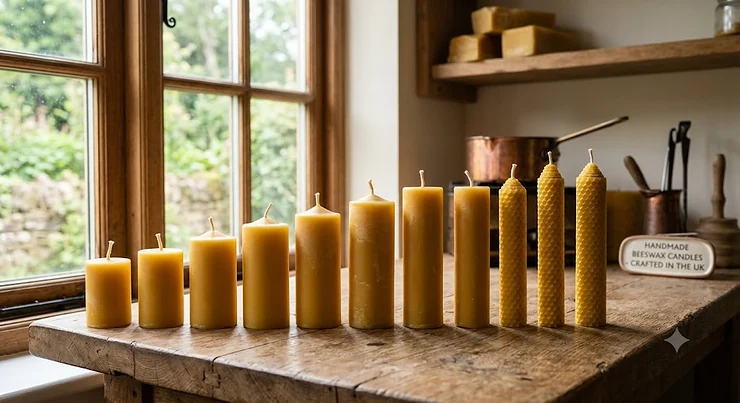
100% pure beeswax candles are candles made entirely from beeswax, the natural substance honeybees secrete to build their honeycomb, with no paraffin, soy, palm oil, synthetic fragrance or dye mixed in. That’s the whole definition. It sounds almost too simple to need spelling out, and yet the candle aisle is absolutely stuffed with products that borrow the word “beeswax” for its warm, honeyed halo of goodness while actually containing a fraction of the real thing.
Here’s the thing nobody tells you when you first go looking: “beeswax candle” and “100% beeswax candle” are, legally and practically, two very different products. The first can mean anything from 51% beeswax blended with cheap paraffin filler to a candle that’s basically 90% soy with a beeswax whisper for marketing purposes. The second means exactly what it says, which is precisely why it costs more, burns differently, and smells like honey rather than a scented-candle-aisle approximation of honey.
If you’ve ever lit a candle labelled “beeswax” and been disappointed by black soot streaking up the jar or a synthetic sweetness that didn’t quite ring true, you’ve probably met one of those blends. A genuine beeswax candle burns with a warm, steady flame, throws almost no soot, and carries only the faintest natural honey scent that comes from the wax itself, not from anything added to it. This guide walks through seven candles that are genuinely, verifiably 100% beeswax, unpacks what terms like raw, unbleached, untreated and additive-free actually mean on a label, and helps you work out which one suits your home, your budget, and your nose.
Quick Comparison Table
| Candle | Wax Source | Scent | Wick | Price Range | Best For |
|---|---|---|---|---|---|
| Gwenyn Gruffydd Welsh Beeswax | Welsh & British apiaries | Unscented | Cotton | £15-£35 range | Traceable single-origin wax |
| Gold&Black Handmade Beeswax | UK small-batch | Unscented | Self-trimming cotton | Under £15 to £40 range | Guaranteed pure ingredient list |
| The London Beeswax Candle Co | Small-scale London apiaries | Both available | Eco-cotton | £20-£45 range | Artisan gifting and luxury shapes |
| The Yorkshire Beeswax Candle Co | Own hives + local beekeepers | Both available | Cotton | £10-£30 range | Widest scented/unscented range |
| Danilovo Beeswax Tapers | Not specified by seller | Unscented | Cotton | Under £15 for bulk pack | Budget bulk and prayer tapers |
| JONERAY Beeswax Pillars | Not specified by seller | Unscented | Cotton | Under £15 | Budget hand-rolled starter set |
| Skär Organics Beeswax Pillar | Certified organic European apiaries | Unscented option + scented | GOTS organic cotton | £25-£50 range | Certified organic premium pick |
A pattern jumps out fast: price correlates more with traceability and batch size than with raw material quality, since every candle here uses genuinely pure wax. What separates a £12 bulk taper pack from a £40 single pillar isn’t purity, it’s whether you know which county, or even which hive, the wax came from, and how much hand-finishing went into the piece sitting in front of you. If provenance matters to you, spend at the top of the table. If you just want honest, additive-free light for a fiver a candle, the budget end is not a compromise on purity, only on ceremony.
💬 Just one click — help others make better buying decisions too!😊
Top 7 100% Pure Beeswax Candles: Expert Analysis
1. Gwenyn Gruffydd Welsh 100% Pure Beeswax Candles — genuinely traceable Welsh apiary wax
The standout here is provenance you can actually pin to a map: this is a rural West Wales honey farm making candles by hand from Welsh and British beeswax, not an anonymous supplier three importers removed from any hive.
Every candle is made from the wax cappings left over after honey extraction, which the brand doesn’t dye, bleach or scent, meaning the colour shifts gently from pale gold to deep amber depending on the season’s forage, exactly as raw beeswax should. Based on the spec comparison, this is about as close as you’ll get to lighting the honeycomb itself: no synthetic fragrance, no artificial colourant, no bleaching process, just cotton wick and wax. What most buyers overlook is that this batch-to-batch colour variation, which some shoppers initially mistake for inconsistency, is actually the single most reliable visual proof of genuine, unadulterated beeswax; a candle that’s identically buttercup-yellow in every batch has almost certainly been standardised with dye.
We couldn’t verify a large, aggregated body of third-party customer reviews for this small farm-based maker in the way we could for bigger retailers, so rather than invent sentiment, it’s worth saying plainly: what we can confirm comes from the brand’s own product documentation, which is explicit about sourcing and process. If independent verification matters to you before buying, the farm’s plastic-free packaging and clear apiary sourcing are at least a genuinely transparent starting point.
Pros:
✅ Clearly traceable to named Welsh and British apiaries
✅ No bleach, dye or synthetic fragrance anywhere in the process
✅ Plastic-free packaging matches the eco positioning
Cons: ❌ Limited independent review volume to cross-check against ❌ Natural colour variation may surprise buyers expecting uniformity
Prices typically sit in the £15-£35 range depending on candle size, and the value verdict is straightforward: if traceability to a real, small-scale apiary matters more to you than uniform presentation, this earns its place.
2. Gold&Black Handmade Beeswax Candles — the most explicit guaranteed-pure ingredient list
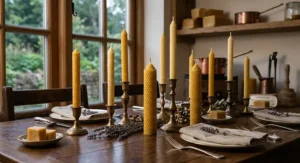
The standout feature is refreshing bluntness: the brand states outright that its candles contain just 100% pure beeswax and a cotton wick, with an explicit list of everything they deliberately leave out, including dye, fragrance, bleach, soy, paraffin, palm wax and even softening agents like coconut oil.
That level of specificity matters more than it might first seem. Plenty of “pure beeswax” marketing copy simply doesn’t mention softening agents or filler waxes at all, which leaves the door open for them to be present without technically lying. Here’s what to weigh: candles are hand-poured in small batches using a 24-hour slow-cooling process specifically to help pillar and church candles hold their form and finish, and the range even includes an ivory colourway achieved through filtration rather than any bleaching agent, which is a genuinely useful option for anyone who wants a lighter shade without touching the “unbleached” claim.
Reviewers on the brand’s own site consistently reference the self-trimming wicks as a practical touch that reduces the faffing around with wick trimmers that beeswax candles are notorious for, though as with any single-retailer review base, that sentiment should be read as brand-reported rather than fully independent. Tea lights start at well under £1 each, making this one of the more accessible entry points into genuinely additive-free candles on this list.
Pros:
✅ Explicit written guarantee against fillers, softening agents and bleach
✅ Ivory shade achieved via filtration, not chemical bleaching
✅Fresh weekly batches rather than long-stored stock
Cons:
❌ Review sentiment is largely brand-hosted rather than independently aggregated
❌ Hand-poured small-batch production means occasional size variation
Prices range from under £1 for a single tea light up to around £40 for larger church-style pillars, positioning this firmly as a mid-range, ingredient-transparent choice.
3. The London Beeswax Candle Company Hexagon Pillar — best artisan design from small-scale beekeepers
The standout is the shape itself: rather than a plain cylinder, this candle is moulded into a honeycomb-inspired hexagon, which sounds like a gimmick until you realise it’s a rare case of a candle’s form actually referencing the material’s own origin.
Wax is sourced exclusively from small-scale London beekeepers, and the eco-cotton wicks are chosen to complement a design ethos that leans deliberately artisan rather than mass-manufactured. On paper this means you’re buying urban apiary wax, which supports city pollination in a genuinely practical way rather than as an abstract feel-good claim; London’s beekeeping scene has grown specifically because rooftop and garden hives thrive in the capital’s surprisingly diverse plant life. Packaging is reused and biodegradable rather than newly manufactured for each order, which fits neatly with the brand’s stated zero-waste ambitions.
What most buyers overlook is that hexagonal and other sculptural pillar shapes burn slightly differently to a plain cylinder, since the surface area exposed to air varies as the candle burns down; expect a marginally faster initial burn that evens out once the flame reaches the more uniform core. This is a candle designed as much for visual impact and gifting as for utility, and the price reflects that positioning.
Pros:
✅ Distinctive honeycomb-referencing hexagon design
✅ Wax sourced specifically from small-scale London apiaries
✅ Reused, biodegradable packaging as standard
Cons:
❌ Premium pricing relative to plainer pillar shapes
❌ Sculptural shape burns slightly less predictably than a simple cylinder
Prices generally range from £20-£45 depending on size, making this best suited to gifting occasions or anyone who wants their candle to double as a genuinely handsome object.
4. The Yorkshire Beeswax Candle Company Scented and Unscented Range — widest choice under one roof
The standout feature is sheer range: this Hebden Bridge-based, family-run business stocks both scented and unscented lines side by side, sourced from over 43 of their own beehives supplemented by local beekeepers’ wax, so you can match the format to the mood without switching brands.
The unscented core range is where the “100% pure beeswax candles unscented” search actually gets satisfied properly, since these carry nothing beyond the wax’s own faint honey note, while the scented line adds organic plant-based essential oils rather than synthetic fragrance oils, keeping the additive-free ethos intact even where scent is deliberately introduced. Based on the spec comparison, what sets this apart from single-product artisan makers is genuine operational scale: 43-plus hives is a serious apiary, not a hobbyist side hustle, which explains why the range extends into wax melts and natural cosmetics as well as candles.
Reviewers consistently note the brand’s transparency about blending their own hive wax with local beekeepers’ supply during high-demand periods, rather than quietly padding out stock with unspecified wax, which is a more honest approach than many competitors take. The business recently consolidated from two physical shops into one Hebden Bridge base due to demand, a detail worth mentioning since it signals genuine, ongoing growth rather than a fading operation.
Pros:
✅ Genuine choice between unscented purity and essential-oil-scented options
✅ Substantial own-hive apiary rather than reseller-only sourcing
✅ Transparent about blending own and local beekeepers’ wax
Cons:
❌ Scented range, while additive-free, isn’t suitable if you want zero fragrance at all
❌ Recent shop consolidation may affect stock availability regionally
Expect prices in the £10-£30 range across tea lights through to pillar candles, making this a strong all-rounder for households who want both scented ambience and genuinely unscented options.
5. Danilovo 100% Pure Beeswax Taper Candles — best budget bulk pack for prayer and ritual use
The standout is pure practicality at scale: fifty slim, bendable taper candles in a single pack, specifically designed for the kind of frequent, repeated lighting that church, prayer and ritual use demands.
These tapers are genuinely thin, at roughly 5mm in diameter and 16cm tall, a format chosen deliberately so they fit standard votive holders without needing to be trimmed or forced. The description explicitly states no soot and a dripless burn, both of which are realistic claims for genuine beeswax at this diameter, since thinner tapers burn hot and clean far more reliably than thick pillars, which can struggle to maintain a full melt pool. What most buyers overlook is that “bendable” is a genuine indicator of purity rather than just a manufacturing quirk, since pure beeswax retains a degree of pliability at room temperature that paraffin-blended candles typically lack.
Reviewers consistently rate this pack well for exactly the use case it targets, being frequent, short-duration lighting rather than long ambient burning, and the pack size makes the cost-per-candle extremely low. What we can’t verify independently is the specific apiary source, since the seller doesn’t disclose this beyond confirming 100% beeswax composition, so if traceability to a named apiary matters to you specifically, this is a weaker fit than the artisan options above it.
Pros:
✅ Genuinely low cost-per-candle across a 50-pack
✅ Slim, bendable format confirms authentic pure beeswax pliability
✅ Purpose-built for frequent ritual or prayer use
Cons:
❌ Apiary source isn’t disclosed beyond “100% beeswax”
❌ Not designed for long, single-sitting ambient burning
At under £15 for the full bulk pack, the value verdict here is simple: if you need reliable, repeated tapers rather than a single statement candle, this is hard to beat on cost.
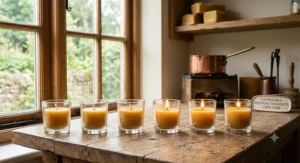
6. JONERAY Beeswax Pillar Candles, Hand-Rolled Set of 4 — best budget entry into pure beeswax
The standout feature is the hand-rolled construction itself: rather than being poured into a mould, these pillars are made by rolling sheets of beeswax around a wick, a technique that’s genuinely one of the oldest and simplest ways to make a candle, and one that leaves the wax essentially untreated beyond the initial sheeting process.
That hand-rolled method means minimal processing between hive and finished candle, which fits neatly with the “raw beeswax candles” and “untreated beeswax candles” search intent this article also covers, since there’s no pouring, moulding or extended heating cycle involved. The set of four is unscented, smokeless and dripless according to the product description, and the visible rolled layers give the candles a distinctive ridged texture that plain poured pillars don’t have.
Here’s what to weigh: at this price point, you’re trading the fine surface finish and consistent sizing of a poured candle for genuine simplicity of process and a noticeably lower cost per candle. Reviewers on retailer listings mention the rolled texture positively as a rustic, handmade aesthetic, though as with the other budget options here, we couldn’t independently verify a large volume of aggregated review sentiment, so treat that as a reasonable but not exhaustively confirmed impression.
Pros:
✅ Hand-rolled method means minimal processing of the wax
✅ Genuinely low price for a set of four
✅ Distinctive ridged texture from the rolling technique
Cons:
❌ Less refined surface finish than poured alternatives
❌ Limited independently verifiable review volume
Typically priced under £15 for the set, this is a sensible first purchase if you want to try genuine beeswax without committing to a premium artisan price tag.
7. Skär Organics Certified Organic Beeswax Pillar Candle — best certified organic premium pick
The standout is certification rather than a marketing claim: this pillar is made from certified organic European beeswax with a GOTS-certified organic cotton wick, which means an independent body has actually verified the organic status rather than the brand simply asserting it.
The beeswax comes from apiaries in low-intervention beekeeping regions, notably including forested hills in Romania, where organic certification protects the surrounding ecosystem as much as the wax itself, since pesticide-free foraging land is a prerequisite for organic honey and wax alike. On paper this means the “unbleached beeswax” claim is backed by certification standards that specifically prohibit chemical bleaching, rather than relying on marketing language alone. Sizes run from a 520g pillar offering more than 70 hours of burn time up to a 700g version rated beyond 100 hours, and the unscented natural colourway sits alongside paprika and green tea variants, both coloured through natural infusion rather than synthetic dye.
What most buyers overlook is that certified organic wax typically costs more not because the wax itself performs differently, but because certification, auditing and traceable supply chains carry real administrative cost that gets passed through to the retail price. Reviewers consistently praise the burn time relative to size, though independent, large-scale review aggregation for this specific product line remains limited, so we’d encourage treating brand-reported satisfaction as indicative rather than exhaustively verified.
Pros:
✅ Independently certified organic beeswax and cotton wick
✅ Genuinely long burn times, 70-100+ hours depending on size
✅ Natural paprika and green tea colourways avoid synthetic dye
Cons:
❌ Among the more expensive options on this list
❌ Independent review volume is limited compared with major retailers
Prices generally sit in the £25-£50 range depending on size, and for anyone who wants certification, not just claims, backing up every part of the purity story, this is the pick that delivers it.
What Does “Raw” Actually Mean on a Beeswax Candle Label?
Raw beeswax candles refers to wax that’s undergone the bare minimum of processing between the hive and the finished product, essentially just melting to remove obvious debris like propolis and bee parts, with no further refining, bleaching or filtering beyond a basic strain.
According to information from the British Beekeepers Association on the various products bees create beyond honey, beeswax is secreted by worker bees from special glands and used to build the comb structure that holds honey, pollen and developing brood, which means the starting material is already remarkably pure before any human processing begins. Raw wax retains natural variations in colour and a stronger honey scent than heavily filtered or refined wax, since the process of extensive filtering strips out some of the aromatic compounds along with the visual impurities. It’s worth being honest here: raw doesn’t automatically mean better performing, since a small amount of fine filtration genuinely helps wick consistency and reduces the chance of a candle spitting as it burns through trapped debris. What raw does guarantee is that you’re getting closer to the wax as the bees actually produced it, with less intervention between hive and holder.
Unbleached Beeswax Explained: Why Colour Varies Batch to Batch
Unbleached beeswax is beeswax that hasn’t been treated with chlorine, hydrogen peroxide or other chemical bleaching agents to force it toward a uniform pale or white shade, meaning its natural colour, anywhere from pale gold to deep amber, is left to vary as the seasons and forage change.
According to Wikipedia’s entry on beeswax, the substance has a relatively low melting point range of 62 to 64°C and will discolour if heated above 85°C, which is a useful fact in itself, since candle makers deliberately keep processing temperatures well below that threshold specifically to preserve the wax’s natural colour and structure rather than degrade it through excess heat. Genuinely unbleached beeswax can also develop a fine, whitish surface coating called bloom over time, caused by softer oils naturally rising to the surface; this is frequently mistaken for a manufacturing fault, when it’s actually one of the clearest visual signals that no chemical whitening agent has been used to lock in an artificially uniform appearance. If bleaching bothers you as much as it should, given that chlorine-based whitening leaves trace chemical residue in the finished wax, checking for batch-to-batch colour variation and the occasional appearance of bloom is a far more reliable purity test than trusting the word “natural” printed on packaging alone.
Additive Free Candles: What’s Really Hiding in “Beeswax Blend” Labels
Additive free candles contain nothing beyond wax and wick, which sounds obvious until you start reading ingredient lists closely and discover how many “beeswax” products actually include stearic acid, paraffin, synthetic fragrance oils, dye or vybar hardeners without ever using the word “additive” on the front of the pack.
The phrase to watch for is “beeswax blend”, which is doing an enormous amount of quiet work on a label; a blend can legally contain as little as a small minority of actual beeswax, with the remainder made up of cheaper paraffin or soy filler that mimics beeswax’s appearance without its performance or purity. Genuinely additive-free candles, by contrast, will state 100% beeswax explicitly, list a cotton or occasionally hemp wick as the only other component, and avoid vague catch-all phrases like “natural wax blend” that sound reassuring while telling you almost nothing. Common mistakes when hunting for additive-free options include trusting a strong honey scent as proof of purity, since synthetic honey-scented fragrance oils are widely available and frequently used precisely to disguise a lower-beeswax-content blend, and assuming a higher price automatically means fewer additives, when in reality some premium-priced candles are simply beeswax-scented soy or paraffin sold at a beeswax-adjacent price point.
Untreated Beeswax Candles vs Filtered and Refined Wax
Untreated beeswax candles use wax that hasn’t been through industrial refining processes like solvent extraction, high-heat clarification or chemical stabilisers, sitting at the least-processed end of a spectrum that runs from raw cappings wax through to heavily refined, cosmetic-grade beeswax pellets.
The trade-off runs in both directions rather than favouring one extreme outright: untreated wax carries more of the hive’s natural character, including subtle scent variation and colour depth, but can also contain slightly more residual propolis or pollen, which occasionally causes a marginally uneven burn or a small amount of extra soot on the wick tip. Refined and filtered wax, by contrast, burns more predictably and consistently across batches, which matters more for commercial-scale production than for a single candle you’re lighting on your kitchen table. For most home use, lightly filtered but otherwise untreated wax hits the practical sweet spot, straining out genuine debris while leaving the wax’s natural composition, waxes, esters and free fatty acids intact rather than industrially stripped and reconstituted. If a listing specifically states “unrefined” or “untreated” alongside “100% beeswax”, that’s a reasonably strong signal you’re getting wax close to its original hive state rather than a heavily processed cosmetic-grade pellet melted down for candle use.
Pure Beeswax Candles Unscented: Why No Fragrance Is a Feature, Not a Flaw
Pure beeswax candles unscented refers to candles that carry no added fragrance whatsoever, relying entirely on beeswax’s own faint, natural honey-and-hive aroma rather than essential oils or synthetic scent compounds layered on top.
This matters more than it might initially seem for anyone with fragrance sensitivities, asthma or a simple preference for a calmer sensory environment, since even “natural” essential oil scented candles can trigger reactions that a genuinely unscented beeswax candle won’t. Reviewers consistently describe the natural scent of unscented pure beeswax as subtle rather than absent entirely, a warm, faintly sweet note that’s noticeable within a metre or two of a lit candle rather than filling an entire room the way a heavily fragranced candle would. What most buyers overlook is that this restraint is actually the point: an unscented beeswax candle is designed to provide light and gentle ambience without competing with dinner, perfume, or a partner’s aversion to strong smells, which is precisely why several of the brands in this guide, including Yorkshire Beeswax and Gwenyn Gruffydd, maintain a dedicated unscented line alongside their scented ranges rather than treating fragrance-free as an afterthought.
✨ Don’t Miss These Exclusive Deals!
🍯 Take your candle drawer to the next level with these carefully selected picks. Click on any highlighted item to check current pricing and availability. These candles bring genuinely clean, honest light into any room without a single synthetic additive.
Artisan Beeswax Candles: Small-Batch Craft vs Mass Production
Artisan beeswax candles are made in small batches, typically hand-poured, hand-dipped or hand-rolled by a maker who can usually tell you which apiaries their wax came from, in contrast to mass-produced candles manufactured on automated lines from pooled, often untraceable wax sources.
The genuine difference isn’t purely romantic; small-batch production allows makers to reject substandard wax batches, adjust wick sizing by hand for individual candle diameters, and maintain the kind of quality control that’s harder to scale industrially without cutting corners somewhere. A piece from Rowen & Wren’s profile of a Cumbrian chandlery captures this well, describing candlemakers who hand-thread cotton wicks around a dipping carousel and judge candle thickness by feel and experience rather than automated calibration alone, a level of craft that inevitably costs more per candle than a factory run. That said, artisan doesn’t automatically mean better performing on every metric; a skilled industrial producer using genuinely pure wax and rigorous quality control can still burn as cleanly as a hand-poured candle. What artisan production reliably does offer is traceability, smaller environmental footprint per batch, and support for the kind of small UK beekeeping operations that keep local pollinator populations healthy, which is arguably the strongest practical argument for paying the artisan premium.
How to Choose 100% Pure Beeswax Candles
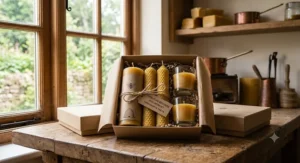
Choosing well comes down to matching seven considerations to your actual priorities, rather than assuming the most expensive option is automatically the purest.
- Check for “100% beeswax” explicitly stated. Anything phrased as “beeswax blend” or “natural wax blend” likely contains significant non-beeswax filler.
- Look for batch-to-batch colour variation. Genuinely unbleached, untreated wax varies in shade; suspiciously uniform colour across every purchase suggests standardisation.
- Prioritise disclosed apiary sourcing if traceability matters to you. Brands willing to name their region or beekeepers are generally more confident in their supply chain.
- Match scent preference deliberately. Choose a dedicated unscented line if fragrance sensitivity matters, rather than assuming “natural” scent equals mild enough.
- Consider wick material. Cotton is standard and reliable; avoid metal-core wicks, which have been restricted in several markets over lead-content concerns.
- Weigh burn time against price per hour, not just sticker price. A £45 candle rated for 100 hours can be cheaper per hour than a £15 candle rated for 20.
- Read reviews with appropriate scepticism for smaller brands. Independent review volume genuinely varies between major retailers and small artisan makers, and that’s not automatically a red flag.
Common Mistakes When Buying Beeswax Candles
Even careful shoppers fall into a handful of predictable traps when hunting for genuinely pure beeswax candles, and most of them trace back to trusting label language that sounds precise without actually being so.
Assuming any product with “beeswax” in the name is majority beeswax is probably the single biggest error, since regulations in most markets don’t require a minimum beeswax percentage before the word can appear on packaging. Trusting a strong honey scent as proof of purity is a close second, given how convincingly synthetic honey fragrance oils can mimic the real thing, and it’s precisely the opposite of a reliable signal, since genuinely pure beeswax’s natural scent is comparatively subtle. Buying based on uniform colour, assuming consistency signals quality, is another frequent misstep, when in reality that uniformity more often indicates either bleaching or blending with a more colour-stable wax like paraffin. Overlooking wick material entirely catches out plenty of buyers too, since a genuinely pure wax candle loses much of its additive-free appeal if it’s burning on a wick containing metal or synthetic cores. Finally, dismissing smaller artisan makers for having fewer online reviews than major retailers ignores that review volume tracks customer base size, not product quality, and some of the purest candles on the market come from businesses too small to have accumulated thousands of ratings yet.
100% Pure Beeswax Candles vs Soy and Paraffin
Understanding how beeswax genuinely differs from soy and paraffin explains why it costs more, and whether that premium is worth paying for your specific use case.
| Factor | 100% Beeswax | Soy Wax | Paraffin |
|---|---|---|---|
| Source | Natural, from honeybees | Processed soybean oil | Petroleum byproduct |
| Melting point | 62-65°C | 49-82°C depending on blend | 46-68°C depending on blend |
| Processing level | Minimal, natural filtering | Significant chemical hydrogenation | Refined from crude oil |
| Typical burn time (equal weight) | Longest of the three | Moderate | Shortest, burns fastest |
| Natural scent | Faint honey, no additives needed | None, requires added fragrance | None, requires added fragrance |
Beeswax’s higher melting point is the real engine behind its longer burn time; because the wax needs more heat energy to liquefy, it burns more slowly than paraffin’s noticeably lower melting range, which is why a beeswax candle can comfortably outlast a same-sized paraffin candle by a significant margin. Soy sits in an odd middle ground: it’s plant-derived and biodegradable like beeswax, which explains its popularity as an eco-conscious alternative, but it requires meaningful chemical processing to hydrogenate the oil into a solid wax, unlike beeswax’s comparatively gentle, natural production. Paraffin remains the cheapest option precisely because it’s a mass-produced petroleum byproduct requiring the least specialised sourcing, but that low cost comes with a genuine trade-off in both burn quality and the fact that it carries no inherent natural scent, meaning virtually all paraffin candles rely on added fragrance to have any smell at all.
Practical Usage Guide: Burning, Trimming and Storing Your First Beeswax Candle
Getting the first few burns right sets the pattern for how evenly a beeswax candle performs across its whole life, and it’s a stage that’s easy to rush past.
On first lighting, let the candle burn long enough for the entire top surface to liquefy into a full melt pool before extinguishing it, since beeswax’s higher melting point means this can take noticeably longer than a paraffin or soy candle of the same diameter, sometimes an hour or more for a wide pillar. Skipping this step risks tunnelling, where the flame burns a narrow well down the centre and leaves a thick, unused rim of wax around the edge. Trim the wick to around 5mm before every burn using proper wick trimmers or clean scissors, since an overly long wick causes larger flames, faster consumption and more soot, even on genuinely pure wax. For storage between uses, keep candles somewhere cool and away from direct sunlight, since beeswax’s relatively low melting point means it can soften or slump in a warm car boot or a sun-facing windowsill far more readily than paraffin. According to safety guidance from the London Fire Brigade, candles should never be left unattended and should always sit on a stable, heat-resistant surface away from anything flammable, advice that applies just as firmly to pure beeswax as to any other candle type, since the flame itself carries the same fire risk regardless of what the wax is made from.
Real-World Scenarios: Which Beeswax Candle Suits Which Home
Scenario one: the fragrance-sensitive household. Someone in the home reacts to synthetic scents, and the priority is genuinely clean-burning ambient light without any fragrance layer. The Yorkshire Beeswax Company’s dedicated unscented line, or Gwenyn Gruffydd’s completely fragrance-free Welsh candles, both deliver light without any additive risk.
Scenario two: the thoughtful gift buyer. The occasion calls for something that looks considered rather than grabbed from a supermarket shelf on the way to dinner. The London Beeswax Candle Company’s hexagon pillar, with its honeycomb-referencing shape and biodegradable packaging, tells a genuinely interesting story that a plain paraffin pillar simply can’t.
Scenario three: the budget-conscious first-timer. Someone wants to try genuine beeswax before committing to premium pricing, without settling for a diluted blend. Danilovo’s bulk taper pack or JONERAY’s hand-rolled set both offer authentic, additive-free wax at a genuinely accessible price point.
Beeswax Candle Not Burning Evenly? Problem → Solution Guide
A beeswax candle that tunnels, gutters or burns unevenly hasn’t necessarily failed as a product, it’s usually one of a handful of fixable habits.
Problem: the flame burns a narrow hole down the centre, leaving wax built up around the rim. This is classic tunnelling, almost always caused by extinguishing the candle before the first full melt pool reaches the edges. Solution: on the very first burn, allow at least an hour, or until the entire surface has liquefied, before putting the flame out.
Problem: the candle produces visible soot or a smoky smell. This typically points to an overly long wick rather than a fault with the wax itself. Solution: trim the wick to roughly 5mm before every single burn, and keep the candle away from draughts, since airflow disturbance is the other major cause of sooting.
Problem: the wax surface develops a whitish, powdery film. This is bloom, caused by natural oils rising to the surface over time, and it’s a sign of purity rather than a defect. Solution: gently buff with a soft cloth, or warm briefly with a hair dryer on a low setting, to restore the glossy finish; it will likely reappear eventually on genuinely pure wax, which is entirely normal.
Problem: the candle feels soft or has slumped out of shape. This usually means it’s been stored somewhere too warm, since beeswax’s melting point, while higher than paraffin’s, is still only around 62-65°C and softens well before that. Solution: store candles somewhere cool and out of direct sun, and allow a softened candle to firm back up at room temperature before burning.
Problem: the flame seems unusually small or struggles to stay lit. This can indicate a wick that’s undersized for the candle’s diameter. Solution: check the product’s stated wick specification against its diameter; if a candle consistently struggles despite correct trimming, it may be a genuine sizing mismatch worth raising with the retailer.
Beeswax Candle Care and Long-Term Value
Treating a beeswax candle with a little basic care changes its total value proposition considerably, since correct burning technique alone can meaningfully extend usable burn time compared with careless handling.
A well-cared-for beeswax pillar, burned in full melt-pool sessions and trimmed consistently, will typically deliver close to its full rated burn time, whereas repeated short burns that never reach a full melt pool waste wax around the rim that never gets used efficiently. Given beeswax’s naturally slower burn rate compared with paraffin or soy, the effective cost-per-hour often works out more favourably than the higher upfront price suggests; a £40 candle rated for 100 hours works out to roughly 40p per hour, comparable to or cheaper than many mid-range paraffin options once you account for how much faster those burn through. Storage matters for longevity too: keeping candles wrapped or boxed away from dust and direct light preserves both appearance and burn quality, since dust settling on an unused wick can affect how cleanly it lights. For anyone building a small rotating collection rather than buying one candle at a time, buying slightly larger pillars from artisan makers like those covered in this guide, rather than frequently replacing smaller ones, generally offers better long-term value once burn efficiency and reduced packaging waste are both factored in.
Features That Actually Matter (And Those That Don’t)
Candle marketing tends to bury genuinely useful information under claims that sound impressive but add little practical value to the purity story this article is actually about.
Features that matter: an explicit “100% beeswax” statement rather than “beeswax blend”; disclosed apiary or regional sourcing, since brands confident in their supply chain tend to say so plainly; a plain cotton wick rather than a vague “eco wick” description with no further detail; and genuine batch-to-batch colour variation, which, counterintuitively, is a purity signal rather than a flaw. Features that matter less than they appear: elaborate scent descriptions layered onto genuinely unscented ranges through marketing copy alone; premium packaging that adds cost without affecting the wax itself; and headline burn-time claims that aren’t backed by a stated candle weight, since burn time scales directly with how much wax is actually in the candle rather than any inherent formula magic. A relevant health and safety point worth flagging alongside all of this: beeswax is genuinely non-toxic and produces minimal soot compared with paraffin, but that doesn’t remove ordinary fire risk, and basic candle safety guidance applies equally regardless of wax purity, so treating a beeswax candle as inherently “safer” to leave unattended would be a mistake worth avoiding.
FAQ
❓ What does 100% pure beeswax candle actually mean?
❓ Is unscented beeswax candle actually scent-free?
❓ Why is raw or unbleached beeswax a different colour every time?
❓ How can I tell if a beeswax candle contains additives?
❓ Do beeswax candles really burn longer than paraffin or soy?
Conclusion
Genuinely 100% pure beeswax candles reward a bit of label literacy: once you know to look past “beeswax” alone and hunt for an explicit 100% statement, disclosed sourcing, and honest colour variation rather than suspiciously uniform shade, choosing well becomes far less of a guessing game. As this guide has shown, purity doesn’t automatically track with price, since a bulk pack of unscented tapers can be just as genuinely additive-free as a premium certified organic pillar, the real differences lie in traceability, scale, and how much ceremony you want attached to your light.
Start by being honest about what actually matters to you: if fragrance sensitivity is the priority, go straight for a dedicated unscented line rather than assuming any beeswax candle qualifies; if traceability to a named apiary matters, spend toward the artisan end of this list; and if you simply want to try genuine beeswax without commitment, a budget bulk pack is a perfectly legitimate, unadulterated way in. Whichever candle from these seven you choose, a little basic care around full melt pools and wick trimming will get you the honest, clean-burning light beeswax has offered for centuries, no synthetic shortcuts required.
Recommended for You
- Best Beeswax Candles on Amazon UK 2026: 7 Pure Picks That Actually Burn Clean
- Beeswax Candles Benefits: 7 Best UK Picks for Cleaner Air in 2026
- 7 Best Beeswax Candles UK 2026 – Natural, Pure & Long-Lasting
Disclaimer: This article contains affiliate links. As an Amazon Associate, I earn from qualifying purchases. If you purchase products through these links, we may earn a small commission at no additional cost to you.
✨ Found this helpful? Share it with your friends! 💬🤗
