
In This Article
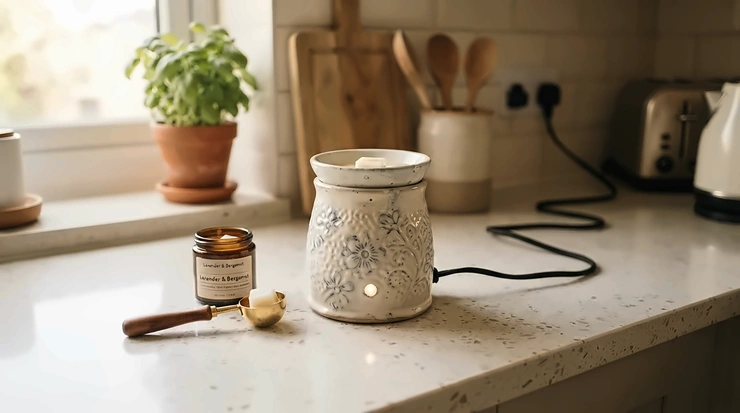
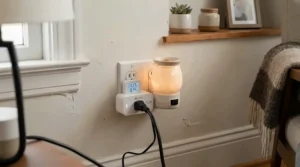
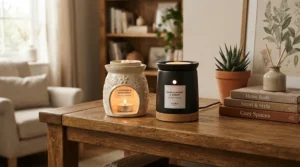
A plug in wax warmer sits directly in a wall socket and melts wax with a low-wattage bulb or small element. A tabletop wax warmer stands on a shelf or sideboard and runs from a cable, or, in the tealight versions, from a small flame. The plug in wax warmer vs tabletop wax warmer decision comes down to three things: how much surface space you can spare, how much heat you need, and how often you plan to move the thing.

Here’s the bit most buying guides skip. These two types are not simply “small” and “big”. They differ in heat source, in wattage, in where the weight sits, and in what happens when somebody knocks into them. A plug in unit hangs its entire weight off a socket. A tabletop unit trades wall space for a cable and a heat-safe surface. Neither is better in the abstract. Each is better for a particular room and a particular routine.
Electric versions across the whole category, which candle warmers as a family typically draw somewhere between 15 and 40 watts while switched on, are cheap to run. Tealight versions draw no electricity at all. That spread in wattage is where the real differences start.
I’ve compared seven real, UK-relevant models across both camps, from budget plug in glass burners to a timer-equipped Yankee tabletop warmer. I’ve weighed their published specs against the review themes I could actually verify. Where I couldn’t verify something, I say so rather than dress it up. Prices below are ranges only, so check current price and availability on Amazon UK before you buy.
Plug In Wax Warmer vs Tabletop Wax Warmer: Quick Comparison
Start with the big picture. This table sorts the three formats you’ll meet while shopping, with the models covered later in this guide slotted in as examples.
| Feature | Plug in warmer | Tabletop electric warmer | Tabletop tealight warmer |
|---|---|---|---|
| Heat source | Low-wattage bulb or small element, often 15–20W | Bulb or flameless heater, commonly 20–25W on full-size designs | Tealight flame, no electricity |
| Surface space needed | None (lives in the socket) | A shelf, sideboard or table | A heat-safe surface |
| Portability | Moves socket to socket | Moves anywhere a socket is in cable range | Moves anywhere, but needs supervision |
| Typical price | Under £15 | Mid-teens upwards | Under £10 |
| Examples | Cello 3D Plug In Electric Warmer, Something Different Daisy Floral Plug In Wax Melt Burner, Supplies For Candles Ribbed Glass Plug-In Wax Warmer | Yankee Candle Kensington Ceramic Electric Melt Warmer, Yankee Candle Addison Scenterpiece Easy MeltCup Warmer, Yankee Candle Glitter Glow Electric Melt Warmer | Yankee Candle Pebble Wax Melt Warmer |
| Best For | Small rooms, hallways, tight spaces | Living rooms, decor-led spaces | Power-free spots, if you’ll stay in the room |
Reading across the rows, the plug in group wins on space and price, while tabletop electric wins on presence and, typically, on bulk heat. The Yankee Candle Pebble Wax Melt Warmer wins on pure cost, but it’s the only one on this list with an open flame, which changes how you should use it. If your priority is a clean shelf, the plug in side of the plug in wax warmer vs tabletop wax warmer debate is hard to beat.
💬 Just one click — help others make better buying decisions too!😊
Top 7 Wax Warmers: Expert Analysis of Plug In and Tabletop Picks
A quick note on method. Everything below is based on published specifications and the review sentiment I could verify. I haven’t tested these products myself, so you won’t find invented hands-on anecdotes here. Where a listing doesn’t publish a wattage, I say so, because guessing would be worse than a gap.
1. Cello 3D Plug In Electric Warmer — slimmest way to scent a hallway
The standout feature is sheer discretion. This warmer takes no shelf space at all, which makes it a natural fit for narrow landings and compact entrance halls.
It ships with a UK 3-pin plug and an on/off switch on the base, and it comes in a range of 3D designs and colours. The retailer describes the heat source as a small bulb. In practice, a base-mounted switch means you can stop the heating without pulling the plug out from behind furniture. That is a bigger convenience than it sounds. The listing doesn’t publish a wattage, so check the pack before buying a replacement bulb.
My analytical take is that this suits renters and small-flat dwellers who want fragrance without giving up a surface. It also suits anyone who likes swapping designs seasonally. I couldn’t verify aggregated customer reviews for this specific model, so treat the retailer’s own pairing advice (use the brand’s melts or oils) as guidance, not proof. Stock varies by design, and at least one design showed as sold out at the time of research.
Pros:
- ✅ Zero shelf space needed
- ✅ Base switch avoids constant unplugging
- ✅ Wide choice of designs
Cons:
- ❌ Wattage not published on the listing
- ❌ Design availability fluctuates
Price: around £15 at the time of research. Good value for a decor-forward plug in unit; check current price.
2. Something Different Daisy Floral Plug In Wax Melt Burner — cheerful glass dish with a built-in switch
If your idea of home fragrance includes a bit of personality, this is the one that nods to cottage-garden style rather than clinical minimalism.
You add wax melts to the glass dish, plug the unit into a mains socket and use the built-in on/off switch. It stands roughly 14cm tall, which is taller than the compact plug in models around it. That matters if your socket sits beneath a shelf or window sill: measure your clearance first, or the dish may foul the shelf above. A sibling Tree of Life silhouette version exists for darker interiors, so the maker clearly designs these as decor pieces.
Based on the spec sheet, this fits buyers who prioritise looks and want a simple, plug-and-go routine. It’s less suited to someone who wants published wattage, as the listing doesn’t state one. I couldn’t find verifiable aggregated reviews for it, so I won’t claim a rating. Ask the seller about the bulb type if you plan to carry spares.
Pros:
- ✅ Decorative floral design
- ✅ Built-in on/off switch
- ✅ No shelf space needed
Cons:
- ❌ Around 14cm tall, so clearance matters
- ❌ Wattage not stated in the listing
Price: budget bracket; check current price. A sensible pick if you buy on style.
3. Supplies For Candles Ribbed Glass Plug-In Wax Warmer — easiest to understand and service
The headline here is transparency. It’s one of the few plug in warmers whose listing tells you what bulb it takes.
It measures around 12.5cm by 9.5cm by 9.5cm, accepts an E14/G30 bulb of up to 20W, and the box includes the unit, a glass wax plate and a bulb. Because E14 is a common small-screw fitting, swapping a failed bulb is not a specialist job. The limit still matters, though: stay at or under 20W, because a higher-wattage bulb overheats the wax and a lower one may barely melt it. The ribbed glass comes in amber, smoke black and clear.
Analytically, this is the best plug in option for anyone who wants to understand and maintain the thing rather than treat it as disposable. The retailer boasts over 10,000 Trustpilot reviews, but that refers to the shop, not this warmer, so I’m not treating it as product evidence. There are no verifiable product-level reviews in my research.
Pros:
- ✅ Published bulb type and 20W limit
- ✅ Standard E14 bulb is easy to replace
- ✅ Glass dish suits wax cubes
Cons:
- ❌ Product-specific reviews not verifiable
- ❌ Glass body shows wax residue
Price: under £10 at the time of research. Strong value for tinkerers; check current price.
4. Yankee Candle Kensington Ceramic Electric Melt Warmer — flameless ceramic vase with a recessed dish
This is the tabletop electric benchmark, and the standout is a tidy vase silhouette that doesn’t scream “wax burner”.
The listing highlights a flameless heater, a recessed heating dish, a long power cord and a low-profile on/off switch, with a UK Type G plug. One stockist gives a compact measurement of around 10cm by 10cm, while another lists larger dimensions, so check the product page carefully. The long cord is a quiet advantage: you can place it where it looks best without hunting for a socket. The unit stays hot for some time after use, so wait before moving it.
For buyers who want a reliable-looking centrepiece for a sideboard, the spec sheet makes sense. At one UK stockist, reviewers collectively gave it a 4.8 rating across 36 reviews. Common themes were that it works well without a lit candle and is easy to clean when changing wax, while one reviewer wished the top section were removable.
Pros:
- ✅ Flameless heater, no candle needed
- ✅ Long cord allows flexible placement
- ✅ Easy to clean between melts
Cons:
- ❌ Top section isn’t removable
- ❌ Stays hot long after switch-off
Price: around £15 to £20 at the time of research. Solid value; check current price.
5. Yankee Candle Addison Scenterpiece Easy MeltCup Warmer — timer for hands-off switch-off
The standout feature is a timer, which tackles the single biggest worry with any electric warmer: forgetting to turn it off.
It is designed for Yankee’s Scenterpiece Easy MeltCups and uses a flameless heater. The cup system makes wax swaps cleaner, because you drop in a self-contained cup rather than scraping a dish. The trade-off is lock-in: you’re committed to that cup format and can’t casually drop loose wax cubes in. I couldn’t verify the timer’s exact duration options for this model, so check the listing.
Based on the specs, this suits busy households and anyone who has ever left a warmer running by mistake. It is less suited to people who buy wax melts in bulk from independent makers. The retailer page carries customer reviews, but I couldn’t verify rating specifics, so I won’t state any.
Pros:
- ✅ Timer reduces forgotten-on risk
- ✅ MeltCups keep swaps clean
- ✅ Flameless heater
Cons:
- ❌ Tied to MeltCup format
- ❌ Timer options need checking
Price: expect it to sit above basic ceramic warmers; check current price. Worth it for the timer alone.

6. Yankee Candle Pebble Wax Melt Warmer — cheapest route, no electricity needed
The standout is cost. This pebble-shaped ceramic warmer is the entry ticket into wax melts, and it needs no socket whatsoever.
It uses an unscented tealight placed in the hollow beneath the dish, and it comes in neutral colourways such as Spa Blue and Grey Lilac. No cable means true freedom of placement, which is handy in a spare room without enough sockets. The catch is the flame. Treat it with the same respect as any lit candle: heat-safe surface, no draughts, no curtains nearby, and never leave it unattended.
Analytically, this works for supervised, occasional use, such as an evening in the lounge or a dinner party. It’s a poor choice for forgetful households or anywhere with pets or small children. One retailer lists 120 reviews for the Spa Blue colourway, a sizeable pool, although I couldn’t verify the average rating.
Pros:
- ✅ No electricity or cable needed
- ✅ Very low purchase price
- ✅ Neutral colours suit most decor
Cons:
- ❌ Open tealight flame needs supervision
- ❌ Weaker heat control than electric
Price: under £10 at the time of research. Best value, but only if you’ll watch it.
7. Yankee Candle Glitter Glow Electric Melt Warmer — illuminated shell you can switch off
The standout here is the glow. The exterior illuminates, and, according to the retailer, that illumination can be switched on or off independently.
It carries a UK 3-pin plug, and the retailer positions it for medium to large living spaces. I’d read that last point cautiously, because a bigger warmer isn’t automatically better in a small room, as I’ll explain later. Switchable lighting is a genuine plus: you can melt wax in a bedroom without a glowing shell, then flip the light back on for a lounge evening.
For decor-led buyers who like a night-light effect, the design logic holds. For minimalists, it’s more theatre than they need. I couldn’t find verifiable aggregated reviews for it, and the wattage isn’t published in the listing I found, so double-check before you buy.
Pros:
- ✅ Illumination can be switched off
- ✅ UK 3-pin plug included
- ✅ Suits larger living spaces
Cons:
- ❌ Wattage not published in listing
- ❌ Overkill for tiny rooms
Price: check current price; expect it to sit above basic ceramic burners. Good for lounges, not for cupboards.
The table below puts the seven side by side so you can see the gaps at a glance.
| Product | Type | Heat source | Wattage (as published) | Price range | Best For |
|---|---|---|---|---|---|
| Cello 3D Plug In Electric Warmer | Plug in | Small bulb | Not stated | Around £15 | Hallways |
| Something Different Daisy Floral Plug In Wax Melt Burner | Plug in | Electric (type not stated) | Not stated | Budget; check | Decor lovers |
| Supplies For Candles Ribbed Glass Plug-In Wax Warmer | Plug in | E14 bulb | Up to 20W | Under £10 | Easy servicing |
| Yankee Candle Kensington Ceramic Electric Melt Warmer | Tabletop electric | Flameless heater | Not stated | £15–£20 | Sideboards |
| Yankee Candle Addison Scenterpiece Easy MeltCup Warmer | Tabletop electric | Flameless heater | Not stated | Check price | Busy households |
| Yankee Candle Pebble Wax Melt Warmer | Tabletop tealight | Tealight flame | None (no electricity) | Under £10 | Supervised, occasional use |
| Yankee Candle Glitter Glow Electric Melt Warmer | Tabletop electric | Electric (type not stated) | Not stated | Check price | Large living rooms |
The pattern is plain. The plug in trio is cheapest and the only group with a published bulb limit, thanks to Supplies For Candles Ribbed Glass Plug-In Wax Warmer. The tabletop electric trio buys you presence, a longer cord and extras such as a timer or lighting. Notice how many wattage cells say “not stated”: that gap is a genuine buying risk, and it’s why the wattage section further down matters.
✨ Don’t Miss These Exclusive Deals!
🔍 Take your home fragrance to the next level with these carefully selected warmers. Click on any highlighted product to check current pricing and availability on Amazon UK. Whichever type you pick, you’ll be well placed to create a welcoming scent your whole household will enjoy!
Setup and Safe-Use Guide: Your First 30 Days
Fragrance is easy. Good habits take a little longer. Here’s a practical routine that works whichever type you’ve chosen.
Week one: placement and first melt. Put a plug in unit in a socket that’s easy to reach and away from curtains, and a tabletop unit on a flat, heat-safe surface, never directly on a polished wooden table that marks. Start with one wax cube, not two. Overfilling is the number-one cause of overflow, particularly in shallow plug in dishes. Allow 15 or so minutes before judging the scent; a slow warm-up is normal.
Weeks two to four: maintenance. Switch off and let the dish cool completely before changing wax. Once the wax has hardened, pop it out with a blunt wooden or rubber tool rather than a metal knife, and bin it rather than pouring it down the sink. Wipe the dish with a dry cloth. If you’ve gone the E14 bulb route, as with Supplies For Candles Ribbed Glass Plug-In Wax Warmer, keep a spare of the correct wattage.
Common first-month mistakes. Buying a bulb by shape alone and ignoring wattage is the classic one. So is leaving the warmer running while you go out. Fire services take this seriously: Essex County Fire and Rescue reported a household wax melt fire involving home-made melts and advised using a melter built for wax melts, not a hot plate or candle warmer, and having a working smoke alarm on every floor.
Finally, nominate one spot for the warmer and stick with it. Moving it daily, particularly a plug in, is when wax gets spilled.
Real-World Scenarios: Plug In Wax Warmer vs Tabletop Wax Warmer for Your Home
Abstract advice only goes so far, so here are three realistic profiles.
The student in a rented room. Budget is under £15, sockets are scarce, and the landlord’s inventory forbids scorch marks. A plug in unit keeps the desk free and costs little. Either Cello 3D Plug In Electric Warmer or Supplies For Candles Ribbed Glass Plug-In Wax Warmer fits. Run it for a couple of hours in the evening, not all day.
The remote worker in a one-bed flat. They’re at home eight hours a day, notice smells quickly and dislike clutter. A low-wattage plug in unit is plenty for one room and won’t overwhelm the space. The Something Different Daisy Floral Plug In Wax Melt Burner works if they want it to look decorative, and the shift from bulb-style heat to a clean routine will suit them.
The family with an open-plan living room. Bigger space, a sideboard to dress, and a real risk of forgotten appliances. A tabletop electric unit with a timer is the sensible match: the Yankee Candle Addison Scenterpiece Easy MeltCup Warmer is built around exactly that worry. If they want a decor statement as well, the Yankee Candle Kensington Ceramic Electric Melt Warmer and Yankee Candle Glitter Glow Electric Melt Warmer are the alternatives.
Notice how often the deciding factor wasn’t “which is better” but “which room, which habits”. If you live somewhere where nobody can supervise a flame, skip the Yankee Candle Pebble Wax Melt Warmer entirely.
Difference Between Plug In and Tabletop Warmers
The difference between plug in and tabletop warmers boils down to four trade-offs: where the weight sits, how the heat is produced, how the cable behaves, and what happens in a knock.
A plug in warmer carries its full weight on the socket faceplate and pins. That’s fine for small, light units, but reviewers of plug in models commonly mention they’re top heavy and lean slightly forward, and one reviewer reported hot wax spilling when the unit swivelled. Tabletop units rest on a surface, so they’re stabler but need real estate.
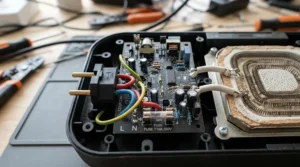
Electrical build quality still matters. A GOV.UK product safety report describes a plug in mini warmer base withdrawn from the market because its neutral and earth pins sat too close together, creating an electric-shock risk. It’s a reminder that “plug in” means the plug itself is part of the safety story.
| Feature | Open-flame tealight burner | Plug in warmer | Tabletop electric warmer |
|---|---|---|---|
| Flame | Yes | No | No |
| Heat control | Limited | Fixed by bulb | Fixed, sometimes timed |
| If knocked | Hot wax and a live flame | Hot wax, may swivel | Hot wax, but stable base |
| Example | Yankee Candle Pebble Wax Melt Warmer | Cello 3D Plug In Electric Warmer | Yankee Candle Kensington Ceramic Electric Melt Warmer |
| Best For | Occasional, supervised use | Small rooms | Decor-led spaces |
The flame-free options remove the most obvious ignition source. Between the electric two, plug in wins on space and tabletop wins on stability, so match the choice to whether your limiting factor is floor space or knock risk.
Heat Source Comparison: Bulb, Element or Tealight?
A proper heat source comparison starts with the three things actually warming your wax.
Bulb. Many plug in and traditional electric warmers use a low-wattage bulb as the heater. It’s cheap, replaceable and doubles as a night light. Wattage is everything: reviewers of replacement bulbs report that ordinary night-light bulbs glow but won’t melt the wax, which is exactly why matched wattage matters. Avoid halogen bulbs, which run far hotter than these designs expect.
Flameless element. Warmers such as Yankee Candle Kensington Ceramic Electric Melt Warmer and Yankee Candle Addison Scenterpiece Easy MeltCup Warmer use a flameless heater instead of a bulb. In theory it delivers steadier, quieter heat and avoids bulb replacement. The downside is you can’t swap in a replacement yourself.
Tealight. The Yankee Candle Pebble Wax Melt Warmer uses a tealight in the hollow below. Heat is gentle and uncontrollable, and, crucially, it’s a naked flame.
Which is “best”? For most homes, a flameless element or correctly matched bulb gives the most predictable melt. Tealight suits the occasional supervised evening. Whichever you pick, buy the wax format the warmer was designed for.
Wattage Differences: What 15W, 20W and 25W Mean in Practice
Wattage differences are more than trivia. They decide how fast wax melts, how strong the scent is, and what the warmer costs to run.
Brand guidance gives a useful rule of thumb. One Scentsy-focused guide says plug in warmers use 15W bulbs, mid-size warmers 20W and full-size warmers 25W, while the wider category runs 15–40W. The Supplies For Candles Ribbed Glass Plug-In Wax Warmer sits in the middle, accepting up to 20W.
More watts doesn’t mean better. Too few and the wax barely softens; too many and it can overheat and overflow. Below is an illustrative running-cost estimate at four hours’ daily use and 27p per kWh (an assumption for illustration, so check your own tariff).
| Bulb wattage | Energy per 4 hours | Approx. cost per year |
|---|---|---|
| 15W | 0.06 kWh | About £6 |
| 20W | 0.08 kWh | About £8 |
| 25W | 0.10 kWh | About £10 |
| 40W | 0.16 kWh | About £16 |
The gap between 15W and 25W is only a few pounds a year, so running cost shouldn’t drive your decision. Room size and scent strength should. A tealight like the Yankee Candle Pebble Wax Melt Warmer costs nothing in electricity, but tealights themselves aren’t free.
Best Wax Warmer Type for Small Rooms
The best wax warmer type for small rooms is usually a low-wattage plug in unit, because bigger isn’t better where air volume is limited.
Here’s the logic. Fragrance fills a space in proportion to heat and wax surface area. In a box room or small bathroom, a 25W tabletop unit can quickly overpower the air, giving you a heavy, almost cloying scent instead of a pleasant one. A 15W plug in model keeps the output modest.
For tight spaces, Cello 3D Plug In Electric Warmer and Supplies For Candles Ribbed Glass Plug-In Wax Warmer are the sensible choices. The first saves floor and shelf space; the second lets you control wattage via the bulb. If you want a decorative shelf piece, Yankee Candle Kensington Ceramic Electric Melt Warmer can work too, as long as you use one cube at a time.
I’d steer away from Yankee Candle Glitter Glow Electric Melt Warmer for very small rooms, since the retailer positions it for larger spaces. Open a window for ten minutes now and then, too. Small rooms trap scent, and ventilation keeps it pleasant.
Portability: Which Warmer Moves Easily?
Portability sounds simple until you try carrying a dish of molten wax across a room.
A plug in warmer is portable in the sense of being small and lightweight. But it’s tied to a socket, it must cool completely before you move it, and it can swivel or lean. Moving it from the lounge to a bedroom each evening is a recipe for spills.
A tabletop electric warmer is bulkier but more forgiving. The long cable on Yankee Candle Kensington Ceramic Electric Melt Warmer lets you shift it a good distance from the wall without much fuss. The catch is that it stays hot after use, so patience is required.
The most portable of all is a tealight warmer such as Yankee Candle Pebble Wax Melt Warmer, because there’s no cable. It travels to a dinner table or a garden room easily, but it needs eyes on it at all times.
So if you need a warmer that follows you around, a tealight is the most mobile, but the least forgiving. For anyone who rarely moves it, a plug in is the tidy choice.
How to Choose Between a Plug In Wax Warmer vs Tabletop Wax Warmer
Short on time? Here’s a six-step shortlist for choosing between a plug in wax warmer vs tabletop wax warmer.
- Measure your space. Under about 10 square metres, lean towards a 15–20W plug in unit; over that, a tabletop model makes sense.
- Check for a free socket and surface. No spare shelf means plug in; no accessible socket means tealight (with supervision).
- Confirm the wattage. Pick models that state a bulb type or wattage, as the Supplies For Candles Ribbed Glass Plug-In Wax Warmer does.
- Look for a timer or switch. A timer, as on the Yankee Candle Addison Scenterpiece Easy MeltCup Warmer, or a base switch, as on the Cello 3D Plug In Electric Warmer, cuts the forgotten-on risk.
- Check the plug. It must be a UK 3-pin plug and suited to 230V mains.
- Match the wax format. Loose cubes, MeltCups and tealight systems aren’t interchangeable.
Work through those six in order and the decision usually makes itself. Most buyers who start torn end up eliminating one type by step three.
Safety, Regulations and Compliance for UK Buyers
In the UK, mains electricity is 230V and domestic plugs are the 3-pin type. Look for UKCA or CE marking on electrical items, and buy from sellers who clearly state the plug type.
This isn’t paranoia. Reviewers of an imported ceramic warmer reported it was wired for 110–120V with a US plug, with one saying an adapter led to a burning-plastic smell and smoke. If a listing doesn’t say it’s UK spec, don’t gamble.
Air quality is the other consideration. Research reported by the American Chemical Society, summarised in an ACS press release, suggests warmed wax melts can release terpenes that may react indoors to form fine particles. That doesn’t mean wax melts are dangerous in normal use, but it supports sensible habits: ventilate, use modest amounts and don’t run warmers for hours in a sealed room.
Don’t leave any warmer running overnight or while you’re out. One UK retailer explicitly advises against overnight use, even for flameless electric models, and a tealight burner is, of course, an open flame. Keep warmers away from curtains, paper and bedding, and out of reach of children and pets. Finally, install a working smoke alarm on every floor.
Common Mistakes When Buying a Wax Warmer
Most regrets come from the same handful of errors.
Buying on looks alone. A beautiful warmer with no published wattage is a gamble. Prefer listings that tell you the bulb type, as Supplies For Candles Ribbed Glass Plug-In Wax Warmer does.
Ignoring the plug. Imported units with the wrong voltage or plug are a recurring complaint in UK reviews.
Using the wrong heater for the wax. Fire services warn against melting wax on a candle warmer or hot plate. Use a melter designed for wax melts.
Overfilling the dish. One cube is enough, particularly in shallow plug in dishes like the Something Different Daisy Floral Plug In Wax Melt Burner.
Locking yourself into a format. The Yankee Candle Addison Scenterpiece Easy MeltCup Warmer only suits MeltCups.
Buying bigger than needed. More watts in a small room just means a heavier scent, and the best wax warmer type for small rooms is usually the modest one.
Fix those six and you’ll avoid most of the disappointment people report.

Frequently Asked Questions
❓ Can I use any wax melt in any wax warmer?
❓ Does a wax warmer with a timer really help?
❓ How hot does the dish stay after switching off?
❓ Is a plug in or tabletop warmer cheaper to buy?
❓ Do I need to replace the bulb in a plug in wax warmer?
Conclusion
So, which wins the plug in wax warmer vs tabletop wax warmer contest? It depends entirely on your room and your routine.
Choose a plug in warmer if space is tight, your budget is modest and you want modest, controllable heat. The Cello 3D Plug In Electric Warmer is the space-saver, the Something Different Daisy Floral Plug In Wax Melt Burner is the decorative option and the Supplies For Candles Ribbed Glass Plug-In Wax Warmer is the best for anyone who wants to understand their wattage.
Choose a tabletop electric warmer if you want a statement piece, a longer cable or extras such as a timer or lighting. The Yankee Candle Kensington Ceramic Electric Melt Warmer is the classic, the Yankee Candle Addison Scenterpiece Easy MeltCup Warmer the safest habit-builder and the Yankee Candle Glitter Glow Electric Melt Warmer the mood-setter for larger lounges. Pick the Yankee Candle Pebble Wax Melt Warmer only if you’ll supervise a flame.
Whatever you choose, check the wattage, confirm UK plug and voltage, use one cube at a time and never leave it running unattended. Do that, and either type will fill your home with fragrance for years.
Recommended for You
- Smart Wax Warmer: 7 Best Picks & Setups For UK Homes (2026)
- Wax Warmer With Light: 7 Best Glowing Picks For UK Homes (2026)
- Wax Warmer With Timer: 7 Best Safe Picks For UK Homes (2026)
Disclaimer: This article contains affiliate links. As an Amazon Associate, I earn from qualifying purchases. If you purchase products through these links, we may earn a small commission at no additional cost to you.
✨ Found this helpful? Share it with your friends! 💬🤗
