
In This Article
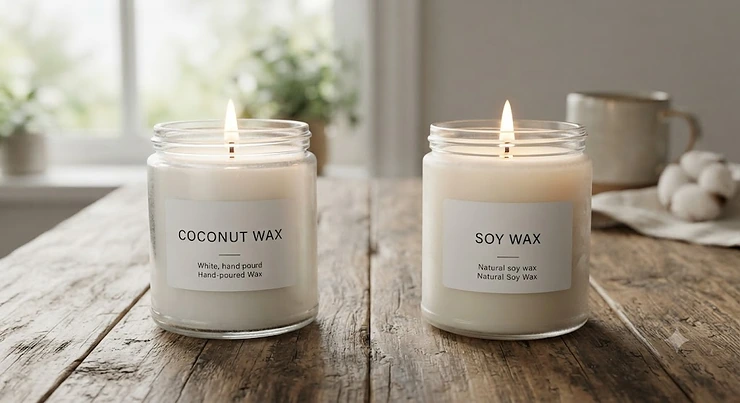
Stand in front of a candle aisle — or worse, an Amazon search results page with thirty-seven pages of options — and the coconut wax vs soy wax candles question starts to feel less like a shopping decision and more like a small existential crisis. Coconut wax is a fluffy white wax pressed from coconut meat, prized for a strong scent throw and a genuinely soot-light burn, while soy wax is a firmer, budget-friendlier wax hydrogenated from soybean oil that’s been the backbone of the “natural candle” boom since the 1990s. Neither is inherently better; they’re just built differently, and the right one depends on what you actually want from a candle.

This guide digs into the actual specs, the actual research on soot and burn quality, and seven real candles and waxes you can buy today — not marketing copy dressed up as advice. We’ll cover why coconut wax costs more than soy (hint: it has almost nothing to do with quality and everything to do with global supply), why “clean burn” claims deserve a little scepticism, and how to match a wax type to your room, your budget and your nose. If you’ve ever lit a candle and wondered why it tunnelled down the middle like a well, or why a fragrance vanished after twenty minutes, the answer usually traces back to the wax itself.
By the end, you’ll know exactly which of these seven candles suits a draughty hallway, a small studio flat, or a dinner party where you want the room to smell incredible without anyone’s eyes watering. Let’s get into it.
Quick Comparison Table
| Candle / Wax | Wax Type | Typical Burn Time | Price Range | Best For |
|---|---|---|---|---|
| Boy Smells Gardener Candle | Coconut oil & beeswax blend | ~50-55 hours | £30-£38 range | Statement scent, premium gifting |
| TooGet Natural Coconut Wax (14oz) | 100% pure coconut wax (DIY) | Depends on pour | £10-£15 range | Candle makers wanting pure coconut |
| NEOM Real Luxury Candle | Soy, rapeseed & beeswax blend | ~50 hours | £28-£40 range | Wellbeing ritual, premium natural blend |
| La Jolíe Muse Soy Candle | 100% soy wax | ~40-45 hours | £15-£20 range | Budget-friendly everyday scenting |
| St Eval Scented Tin Candle | Mineral & vegetable wax blend | ~45 hours | £8-£12 range | Portable, UK-made, mid-range gifting |
| Eco Lux UK Premium Soy Wax (2kg) | 100% soy wax flakes (DIY) | Depends on pour | £10-£15 range | Sustainable DIY candle making |
| Ocoee House Soy Wax Candle | 100% soy wax | ~45-50 hours | £15-£23 range | Small-batch, Scottish-made soy |
Looking at the spread above, the split between finished candles and raw wax for candle making matters more than it first appears — if you’re buying a ready-to-burn candle, burn time and scent throw are what count, but if you’re buying wax by the kilogram, melting point and additive percentage become the real decision points. Note that NEOM Real Luxury Candle and St Eval Scented Tin Candle aren’t pure single-source waxes; both use blends, which is common practice and not a red flag, just something worth knowing before you buy. Budget shoppers should gravitate toward La Jolíe Muse Soy Candle or the raw wax options, while anyone buying as a gift will get more visual and olfactory impact from Boy Smells Gardener Candle or NEOM Real Luxury Candle.
💬 Found a favourite already? Save this page and come back before you check out — the full breakdown below could change your mind.
Top 7 Coconut & Soy Wax Candles: Expert Analysis
1. Boy Smells Gardener Candle — richest scent throw of the coconut blends
The standout here is genuinely the throw: this candle fills a living room, not just the side table it sits on. Boy Smells built its reputation on a proprietary blend of coconut oil, beeswax and other natural waxes rather than pure coconut wax, poured into an 8.8oz glossy black glass tumbler with a braided cotton wick. That blend matters practically — coconut wax alone can be soft and slow to release fragrance, so folding in beeswax firms up the structure and slows the burn to a claimed 55 hours, which is genuinely long for a single-wick candle this size.
Based on the spec comparison with single-wax coconut candles, the beeswax addition is what lets Boy Smells Gardener Candle hold a clean, even melt pool rather than tunnelling — a common complaint with soft, additive-free coconut wax poured into narrow jars. Reviewers consistently report that the Gardener scent (tomato, petitgrain, white tea and honeysuckle) is unusual without tipping into “try-hard niche perfume” territory, and the packaging alone makes it a strong gifting option. This is the pick for someone who wants a genuinely different candle-aisle scent and doesn’t mind paying a premium for it — beginners chasing a classic vanilla or fresh-linen scent should look elsewhere first.
Pros:
- ✅ Long claimed burn time for a single-wick candle
- ✅ Distinctive scent profile not found in mainstream ranges
- ✅ Sturdy glass tumbler that’s reusable after the wax is gone
Cons:
- ❌ Premium price point compared to mainstream soy candles
- ❌ Coconut-beeswax blends can vary batch to batch on scent strength
At around £30-£38, this sits at the premium end of the coconut-wax world — worth it if the scent genuinely appeals to you, harder to justify if you’re buying blind for a gift.
2. TooGet Natural Coconut Wax (14oz) — purest coconut wax for candle makers
This is raw material, not a finished candle, and that’s exactly the point — it’s aimed at people who want to control the fragrance, colour and vessel themselves. TooGet’s coconut wax has a melting point around 41°C (106°F), noticeably lower than most soy waxes, which in practice means faster melt pools and stronger cold throw (the scent you smell from an unlit candle) once it’s cured.
What most first-time candle makers overlook about pure coconut wax is that its softness, the very thing that gives it a lovely cold throw, also makes it prone to sinkholes and an uneven surface if poured too quickly or at the wrong temperature. Reviewers commonly note that the wax performs beautifully once you dial in your process, but it has a steeper learning curve than soy wax flakes, which are more forgiving for beginners. If you’re experimenting with a wooden wick or want the creamiest possible finish for a photographed candle, this is worth the extra patience; if you want a fool-proof first attempt at candle making, soy is the safer starting point.
Pros:
- ✅ Lower melting point than most soy waxes for strong cold throw
- ✅ 100% pure coconut origin, no filler wax blended in
- ✅ Popular with hobbyists making small-batch scented candles
Cons:
- ❌ Steeper learning curve than soy wax for pouring technique
- ❌ Softer set means less suited to freestanding pillar candles
Priced in the £10-£15 range for 14oz, it’s a reasonable entry point if you’re testing whether pure coconut wax suits your candle-making setup before buying in bulk.
3. NEOM Real Luxury Candle — most complex fragrance blend in this line-up
NEOM Real Luxury Candle leans hard into aromatherapy positioning, and the ingredient list backs it up: a blend of up to 19 essential oils including lavender, jasmine and sandalwood, poured into a naturally derived wax blend of soy, rapeseed and beeswax rather than a single wax type. NEOM states its candles are hand-finished in the UK, and the brand holds B Corp certification, which is a genuine third-party sustainability marker rather than a self-awarded label.
On paper, blending soy with rapeseed wax raises the melting point slightly compared to pure soy, which helps the candle hold its shape and burn a touch more evenly across a three-wick format. What the spec sheet won’t tell you, but aggregated customer reviews consistently note, is that the essential-oil-led fragrance is noticeably softer than synthetic-fragrance-oil candles — brilliant if you find heavily perfumed candles headache-inducing, less exciting if you want a scent that fills a large open-plan kitchen from the hallway. This is the pick for buyers who care as much about the ritual and ingredient transparency as the scent throw itself.
Pros:
- ✅ B Corp certified with genuine third-party sustainability vetting
- ✅ Naturally derived wax blend avoids pure paraffin entirely
- ✅ Essential-oil fragrance is gentler on sensitive noses
Cons:
- ❌ Softer scent throw than synthetic-fragrance competitors
- ❌ Among the pricier options in this comparison
Expect to pay in the £28-£40 range depending on size — a premium price, but one that reflects genuine sourcing and certification rather than packaging alone.
4. La Jolíe Muse Soy Candle — best value for everyday scenting
If you burn candles often enough that cost per hour actually matters, La Jolíe Muse Soy Candle is where the maths starts working in your favour. It’s a straightforward 100% soy wax candle without the blended-wax complexity of the pricier options above, which keeps the manufacturing cost — and the shelf price — down.
Here’s what to weigh: soy wax’s lower melting point (roughly 49-82°C depending on the blend, per Wikipedia’s overview of soy candle composition) means it typically distributes fragrance slightly less intensely than paraffin or coconut wax, so don’t expect this candle to compete with Boy Smells Gardener Candle on room-filling power. What it does deliver, based on aggregated review sentiment, is a consistently soot-light, even burn across the jar — the hallmark soy-wax selling point holds up here. For someone furnishing a first flat, replacing candles every few weeks, or buying scented candles as regular household consumables rather than occasional luxuries, this is the sensible default.
Pros:
- ✅ Genuinely affordable cost-per-burn-hour compared to blended waxes
- ✅ Reliable even melt pool typical of straight soy wax
- ✅ Wide range of scent options available in the line
Cons:
- ❌ Noticeably lighter scent throw than coconut or blended candles
- ❌ Less premium packaging and presentation for gifting
At roughly £15-£20, this is the candle to buy on repeat rather than the one you save for a special occasion.
5. St Eval Scented Tin Candle — best portable, UK-made option
Made on a working farm in North Cornwall, St Eval Scented Tin Candle is worth including here precisely because it complicates the coconut-vs-soy framing a little — St Eval’s own FAQ describes its wax as a unique blend of mineral and vegetable waxes rather than a pure soy or coconut formula. That honesty is refreshing in an industry where “natural” gets stretched thin, and it’s worth knowing before you assume every candle marketed as eco-friendly is 100% plant wax.
Reviewers consistently mention a genuinely long burn (up to a claimed 45 hours from a compact tin) and a fragrance that’s noticeably not overpowering, which suits smaller rooms or a bedside table rather than a large lounge. A recurring theme in aggregated feedback is that the value proposition feels a little tight for the tin’s size, though nobody disputes the scent quality or the “made in Cornwall” credentials. This is the pick for travel, camping trips, or anyone who wants a UK-manufactured candle with proven safety testing rather than a purely plant-wax-purist option.
Pros:
- ✅ Compact tin format is genuinely portable and travel-friendly
- ✅ Manufactured and safety-tested in the UK
- ✅ Long burn time relative to its small size
Cons:
- ❌ Wax blend includes mineral wax, not a pure natural formula
- ❌ Some reviewers feel the price is high for the quantity of wax
Priced around £8-£12, it’s a low-commitment way to try a well-regarded British candle maker before investing in a larger jar candle.

6. Eco Lux UK Premium Soy Wax (2kg) — best sustainable DIY soy wax
For anyone leaning into the “sustainable” and “renewable” side of this whole debate, Eco Lux UK Premium Soy Wax is worth a look precisely because it’s marketed and formulated as a vegan, cruelty-free, additive-free soy wax rather than a blend cut with cheaper fillers. At 2kg, it’s positioned for candle makers producing multiple batches rather than a one-off gift candle.
What most buyers overlook about additive-free soy wax like this is that “no additives” is a double-edged claim: it means fewer unknown chemicals in your finished candle, but it also means you’re relying entirely on your own technique — pour temperature, fragrance load and wick sizing — to avoid the frosting (a white, crystalline surface bloom) that pure soy wax is notorious for. Reviewers on similar pure soy waxes commonly report that results are excellent once you’ve dialled in a process, echoing the wider pattern seen across candle-making forums. If you’re candle-making partly for the sustainability angle and partly to control exactly what goes into your home, this is a sound, honestly labelled option.
Pros:
- ✅ Vegan and cruelty-free formulation with no undisclosed additives
- ✅ Good value per kilogram for a 2kg bulk quantity
- ✅ Renewable, biodegradable raw material sourced from soybeans
Cons:
- ❌ Prone to surface frosting without careful temperature control
- ❌ Requires more hands-on technique than pre-blended waxes
At around £10-£15 for 2kg, it’s one of the more genuinely budget-friendly ways into sustainable candle making covered in this piece.
7. Ocoee House Soy Wax Candle — best small-batch Scottish soy candle
Hand-poured in Loch Lomond, Ocoee House Soy Wax Candle represents the small-business end of the UK candle market — organic and vegan positioning, a choice of scent options, and two size formats rather than a single mass-produced SKU. Buying from a small-batch maker like this typically means more manual quality control per candle, though it can also mean less consistency between production runs compared to a large-scale manufacturer.
Based on the spec comparison with the mass-market soy candles further up this list, small-batch soy candles like this one tend to use higher fragrance-oil loads relative to wax volume, because the maker isn’t optimising purely for cost-per-unit at scale. That generally shows up as a stronger cold throw straight out of the box, even though the underlying wax chemistry is the same soy base as La Jolíe Muse Soy Candle. This is a good pick for anyone who wants to support a small UK business and is happy paying slightly more for a more artisanal production process, rather than someone purely optimising for the lowest price per burn hour.
Pros:
- ✅ Hand-poured in small batches by a Scottish small business
- ✅ Organic and vegan formulation with clear sourcing
- ✅ Two size options for different room sizes and budgets
Cons:
- ❌ Batch-to-batch consistency can vary more than large manufacturers
- ❌ Limited scent range compared to bigger commercial brands
Expect to pay roughly £15-£23 depending on the size chosen — a fair mid-range price for a small-batch soy candle with genuine UK provenance.
Practical Usage Guide: Getting the Best Burn From Any Natural Wax Candle
Coconut and soy wax both reward a bit of technique, and most of the disappointment people report with natural wax candles traces back to the first burn rather than the wax itself. On the very first light, let the candle burn long enough for the entire top surface to turn to liquid wax, right out to the edges of the jar — usually one to two hours depending on jar width. Skip this step and you’ll set a “memory ring,” meaning the candle will tunnel down the centre for the rest of its life no matter how long you burn it afterwards.
Trim the wick to around 5-6mm before every single burn, not just the first one — a long wick is the single biggest cause of soot, mushrooming, and an oversized flame on both coconut and soy candles, since neither wax has the additive package that lets paraffin tolerate a longer wick. Keep candles away from draughts, which cause uneven melt pools and rapid, sooty burning regardless of wax type; a draught genuinely wrecks a soy or coconut candle faster than almost anything else. Finally, don’t burn any single-wick candle for more than about four hours at a stretch — beyond that, the wick can overheat the wax and start producing carbon buildup rather than a clean flame. Most first-30-days mistakes with natural wax candles are wick and draught issues, not wax-quality issues, which is worth remembering before you assume a candle is simply “bad.”
Real-World Scenarios: Which Wax Suits Your Life?
If you’re a student in a small shared house burning candles most evenings to make a rented room feel like home, La Jolíe Muse Soy Candle or bulk Eco Lux UK Premium Soy Wax make the most financial sense — soy’s lower cost per burn hour matters far more than maximum scent throw in a small bedroom. If you’re furnishing a first proper flat and want candles that double as considered home decor and occasional gifts, something like St Eval Scented Tin Candle hits a sweet spot of UK provenance, portability and reasonable price without committing to the premium end of the market.
If you’re buying for someone who already owns “every candle” and you want to stand out, Boy Smells Gardener Candle or NEOM Real Luxury Candle are the considered gift picks — distinctive scent, recognisable branding, and a story behind the ingredients that a mainstream supermarket candle simply doesn’t have. And if you’re the kind of person who’s already looked into candle making as a hobby, whether for cost savings or creative control, both TooGet Natural Coconut Wax and Eco Lux UK Premium Soy Wax give you a genuine side-by-side comparison of how the two wax families behave once you’re the one controlling pour temperature and fragrance load.
Problem → Solution: Fixing Common Candle Complaints
Problem: the candle “tunnels” down the middle and stops throwing scent. This is almost always a first-burn issue rather than a wax defect — go back to letting the very first burn run until the full surface melts, and on subsequent burns, aim for at least one hour per inch of jar diameter.
Problem: barely any scent when the candle isn’t lit. This points to cold throw, and it’s where coconut wax genuinely outperforms soy — if scent-when-unlit matters to you, prioritise coconut-based options like Boy Smells Gardener Candle over pure soy picks.
Problem: white, crystalline patches on the surface of a soy candle. Known as frosting, this is a natural characteristic of pure soy wax reacting to temperature changes, not a fault — it’s cosmetic and doesn’t affect burn quality, though additive-free waxes like Eco Lux UK Premium Soy Wax show it more readily than blended waxes.
Problem: the candle burns unevenly with black soot on the jar. Check the wick length first (trim to 5-6mm), then check for draughts — both coconut and soy wax are genuinely low-soot when burned correctly, so persistent sooting usually means an environmental or wick issue rather than a bad candle.
Problem: the candle feels expensive for what you get. Compare cost per estimated burn hour rather than sticker price alone — a £35 candle rated for 55 hours can work out cheaper per hour than a £15 candle rated for 20 hours, which is exactly the maths worth doing before dismissing a premium pick like NEOM Real Luxury Candle as overpriced.
How to Choose Between Coconut Wax and Soy Wax Candles
- Decide how much you care about cold throw. If you want to smell your candle before you’ve even lit it, coconut wax’s lower melting point gives it a genuine, measurable edge.
- Set your actual budget per candle, not just per jar. Soy wax candles are consistently cheaper to manufacture, which usually translates to a lower shelf price for comparable jar sizes.
- Think about how often you’ll actually burn it. Frequent burners benefit more from soy’s cost efficiency; occasional-luxury buyers can justify coconut’s premium more easily.
- Check whether it’s a pure wax or a blend. Products like St Eval Scented Tin Candle and NEOM Real Luxury Candle mix waxes deliberately for performance — that’s not a downgrade, just a different design choice.
- Consider your room size. Coconut wax and coconut blends like Boy Smells Gardener Candle tend to throw scent further, which matters more in open-plan spaces than in a small bathroom.
- Factor in whether you’re candle-making or buying finished. Raw waxes like TooGet Natural Coconut Wax and Eco Lux UK Premium Soy Wax need a bit of a learning curve that a finished candle skips entirely.
- Weigh sustainability claims against actual certification. B Corp status, as held by NEOM, is a stronger signal than an unverified “eco-friendly” label on packaging alone.
Coconut Wax vs Soy Wax Candles: The Real Difference
The honest answer is that both are renewable, plant-derived waxes that beat paraffin on most sustainability measures, and the differences between them are more about performance nuance than one being objectively superior. According to Wikipedia’s overview of soy candle chemistry, soy wax is made by fully hydrogenating soybean oil, a process that pushes the fatty acid profile toward stearic acid and gives the wax its characteristic softness and low melting point — which is why soy candles are usually poured into containers rather than made as freestanding pillars, unless firming additives are blended in. Coconut wax follows a broadly similar logic — it’s pressed and refined from coconut meat rather than soybeans — but tends to run even softer and lower-melting than soy on its own, which is exactly why so many “coconut wax” candles on the market are actually coconut blended with soy, beeswax or a firming additive.
Where the practical difference really shows up is scent behaviour. Coconut wax generally holds a noticeably stronger cold throw than soy, which is why brands chasing a premium “you can smell it before you light it” experience — like Boy Smells Gardener Candle — lean on coconut or coconut-blends rather than straight soy. Soy, meanwhile, wins clearly on cost and availability, since global soybean production dwarfs coconut supply, which is reflected in the shelf price gap between something like La Jolíe Muse Soy Candle and any pure coconut wax equivalent. On emissions and soot, though, the research doesn’t back a clean winner either way — a peer-reviewed emissions study published in ScienceDirect compared paraffin, soy, stearin and palm wax candles under controlled conditions and concluded that the unscented versions of all four wax types behaved very similarly in terms of gaseous and particulate emissions, with no single wax type showing a consistently cleaner profile. That’s a useful reality check against marketing claims that any single “natural” wax is dramatically cleaner-burning than the rest by default — burn technique and wick sizing matter just as much as the wax family itself.
Common Mistakes When Buying Coconut or Soy Wax Candles
The most common mistake is assuming “coconut wax” or “soy wax” on a label means 100% pure wax with nothing else in it — as St Eval Scented Tin Candle and NEOM Real Luxury Candle both demonstrate, reputable brands frequently blend waxes deliberately, and that’s a formulation choice rather than a marketing trick. A second frequent error is buying purely on scent-throw marketing claims without checking jar size against room size — a candle that’s genuinely powerful in a small bathroom can feel disappointing in an open-plan kitchen-diner, regardless of wax type.
Shoppers also commonly overpay for “natural” or “eco” labelling without checking for genuine third-party certification, which is exactly why NEOM’s B Corp status is worth more than an unverified green claim elsewhere. Finally, first-time candle makers frequently buy the cheapest raw wax available without checking melting point compatibility with their chosen fragrance load and wick size — a mismatch here is the single biggest cause of the tunnelling, frosting and poor-throw complaints that get unfairly blamed on the wax type itself rather than the technique.
What to Expect: Real-World Performance
In everyday use, the difference between a well-made soy candle and a well-made coconut candle is more subtle than most marketing suggests. Light La Jolíe Muse Soy Candle and Boy Smells Gardener Candle side by side in the same room and you’ll notice the coconut blend fills the space faster and lingers a little longer once extinguished, while the soy candle burns a touch more predictably and evenly across its full life. Neither should smoke or soot heavily if the wick is trimmed and the first burn was done properly — persistent sooting on either wax type is a sign of technique or draught issues, not an inherent flaw in coconut or soy as a category.
Expect soy candles generally to need slightly more frequent wick maintenance because their lower melt-pool temperature can encourage a touch more carbon buildup on the wick tip over a long burn, while coconut and coconut-blend candles tend to self-trim a little more cleanly thanks to their faster, hotter melt pool. Over a full jar’s lifespan, both wax types should leave minimal residue on glass compared to paraffin, making the jars genuinely reusable once the wax is gone — a small but real sustainability bonus that applies across this entire list.
Coconut Wax Candles Clean Burn: What the Science Actually Says
“Clean burn” is one of the most repeated phrases in candle marketing, and it’s worth separating the genuine science from the sales pitch. The often-cited claim that paraffin uniquely releases toxic compounds while plant waxes release none traces back largely to a single, frequently misquoted study, and more rigorous comparative work tells a more balanced story. A landmark study published in the Journal of the American Oil Chemists’ Society tested hydrogenated soybean oil candles against paraffin and beeswax references, and reported that paraffin combustion produced considerable soot while the soy wax candles produced little to none, burning at a notably slower rate and needing less air to sustain the flame.
That’s a genuinely strong result for soy — and by extension for coconut wax, which shares similar combustion characteristics as another soft, plant-derived wax. But it’s worth pairing with the broader emissions research covered in the comparison section above, which found less difference between plant waxes themselves under lab conditions. The realistic takeaway: coconut and soy wax candles both burn markedly cleaner than poorly made paraffin candles, but “clean burn” between two well-made natural wax candles is mostly determined by wick sizing, fragrance load and burn habits rather than which plant the wax came from.
Sustainable Coconut Wax and Renewable Wax Candles: The Sustainability Picture
Both coconut wax and soy wax qualify as renewable wax candles in the sense that matters most — they’re derived from crops that regrow annually, rather than a finite fossil resource like paraffin. That’s a genuine, meaningful sustainability advantage over petroleum-based candles, and it’s the reason products like Eco Lux UK Premium Soy Wax market themselves so heavily on the renewable and biodegradable angle. But “sustainable coconut wax candles” as a category comes with its own supply chain considerations worth knowing about: coconut is grown in a much smaller number of tropical regions than soy, and demand for coconut-derived products (oil, wax, milk) has risen sharply, which puts more pressure on land use and smallholder farming communities in producing countries.
Candle wax sustainability, in other words, isn’t just about the plant of origin — it’s also about how that crop is farmed, processed and transported before it ever reaches a UK shelf. Look for brands that disclose sourcing details or hold recognised certifications, the way NEOM Real Luxury Candle‘s B Corp status gives buyers a genuine third-party sustainability marker rather than a self-declared “eco” label. Soy, for its part, carries a well-documented association with large-scale monoculture farming in some regions, so neither wax gets an automatic free pass on sustainability grounds — the honest position is that both beat paraffin clearly, while the finer sustainability differences between coconut and soy depend heavily on the specific supplier’s practices rather than the wax type in the abstract.
Eco Candle Options Beyond Coconut and Soy
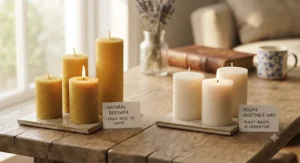
If neither coconut nor soy quite fits the brief, it’s worth knowing the wider field of eco candle options available on the UK market. Beeswax, used in blends by both Boy Smells Gardener Candle and NEOM Real Luxury Candle, is a genuinely renewable by-product of honey production, though supply is naturally limited by hive capacity, which keeps pure beeswax candles firmly in premium pricing territory. Rapeseed wax, blended into NEOM Real Luxury Candle and increasingly common in UK-made candles, has the advantage of being grown domestically in Britain rather than imported, which shortens the supply chain considerably compared to coconut or soy.
Palm wax is technically plant-derived and renewable too, but it carries well-documented deforestation and biodiversity concerns in some sourcing regions unless certified sustainable, so it’s worth checking for RSPO (Roundtable on Sustainable Palm Oil) certification specifically if you see it listed as an ingredient. For UK shoppers who want to minimise wax miles altogether, blends like St Eval Scented Tin Candle‘s mineral-and-vegetable wax formula, produced and tested domestically in Cornwall, offer a genuinely different trade-off — slightly less “purist” on ingredient sourcing, but a shorter, more transparent domestic supply chain than most imported pure coconut or soy wax candles.
Long-Term Cost & Maintenance
Working out genuine value means looking past the sticker price to cost per burn hour, and the numbers here vary more than you’d expect. A La Jolíe Muse Soy Candle priced around £15-£20 with a roughly 40-45 hour burn works out to somewhere in the region of 35-45p per hour, while Boy Smells Gardener Candle at £30-£38 for a claimed 55-hour burn lands in a broadly similar 55-70p per hour range once you account for its larger fragrance load and premium presentation. Neither is objectively “better value” in isolation — it depends whether you’re optimising purely for cost or also paying for scent intensity, packaging and brand experience.
For DIY candle makers, the maths shifts further: buying Eco Lux UK Premium Soy Wax or TooGet Natural Coconut Wax in bulk and pouring your own candles typically costs meaningfully less per finished candle than buying pre-made equivalents, though you’re trading that saving against your own time, equipment costs (melting pots, thermometers, wicks) and the learning curve discussed earlier in this guide. Ongoing maintenance costs for any wax type are minimal and mostly limited to wick trimmers, which cost a few pounds and pay for themselves quickly by extending clean burn life and reducing soot-related jar cleaning.
Safety & Regulations Guide (UK)
Whichever wax you choose, UK candle safety guidance is wax-agnostic — the risks come from open flames, not from whether the wax started life as a soybean or a coconut. London Fire Brigade’s home fire safety guidance is consistent on the fundamentals: never leave a burning candle unattended, and always put it out before leaving the room or going to bed. That applies equally to a £10 soy tealight and a £40 coconut-blend three-wick candle.
Beyond basic supervision, keep candles on a stable, heat-resistant surface well away from curtains, furniture and anything flammable, trim wicks before every burn, and never move a candle while the wax is still liquid, since natural waxes like soy and coconut can produce a surprisingly hot, mobile wax pool in a glass container. UK-manufactured candles from brands like St Eval Scented Tin Candle go through domestic safety testing as standard, which is worth factoring in if regulatory compliance matters to you beyond the wax type itself — it’s a genuinely different consideration from the sustainability and performance questions covered earlier in this guide.

Frequently Asked Questions
❓ Is coconut wax better than soy wax for candles?
❓ Why are coconut wax candles more expensive than soy?
❓ Do soy candles really burn cleaner than paraffin?
❓ Can you mix coconut wax and soy wax together?
❓ Are coconut wax candles vegan?
Conclusion
There’s no single winner in the coconut wax vs soy wax candles debate, and honestly, that’s the useful takeaway rather than a cop-out. Soy wax earns its popularity through cost, availability and a genuinely well-documented clean-burning track record, making budget picks like La Jolíe Muse Soy Candle and bulk Eco Lux UK Premium Soy Wax sensible defaults for everyday use. Coconut wax and coconut blends, meanwhile, justify their premium through stronger cold throw and a more distinctive, room-filling character, which is exactly why Boy Smells Gardener Candle and NEOM Real Luxury Candle lean into that territory rather than competing on price.
What actually matters more than the wax type, based on everything the research and aggregated reviews point to, is buying from a brand that’s transparent about its wax blend, trimming your wick every single time, and matching jar size to room size realistically. Get those three things right and both coconut and soy wax candles from this list — from the small-batch Ocoee House Soy Wax Candle to the UK-made St Eval Scented Tin Candle — will perform close to their best. Whichever you choose, you’re already making a more sustainable choice than a straight paraffin candle, and that’s worth something on its own.
✨ Ready to pick your candle? Check current prices and availability on the options above before they’re gone from stock.
Recommended for You
- Coconut Wax Candles UK: 7 Best Picks & Buying Guide 2026
- Best Pillar Candles 2026: 7 Beeswax & Decorative Picks Reviewed
- 7 Best Beeswax Pillar Candles UK (2026)
Disclaimer: This article contains affiliate links. As an Amazon Associate, I earn from qualifying purchases. If you purchase products through these links, we may earn a small commission at no additional cost to you.
✨ Found this helpful? Share it with your friends! 💬🤗
