
In This Article
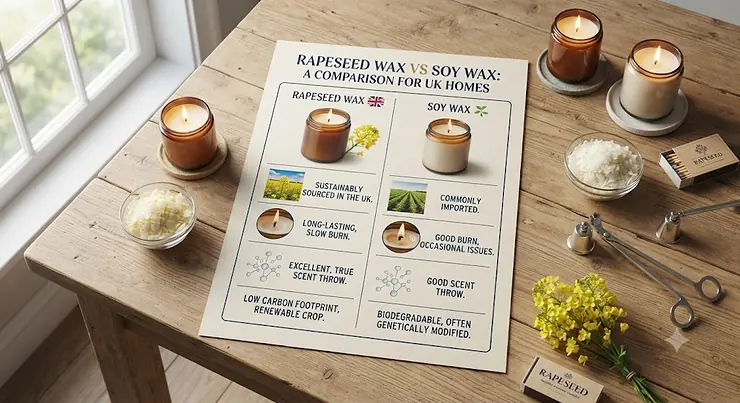
Stand in front of a candle aisle in 2026 and you’ll notice something has shifted. “Paraffin” has quietly become a dirty word, and the labels now compete on a different battlefield entirely: rapeseed candle vs soy candle. Both promise a cleaner conscience and a cleaner burn, but they’re not the same wax wearing two different jackets — they come from different fields, different countries, and different supply chains, and that matters more than most product pages let on.
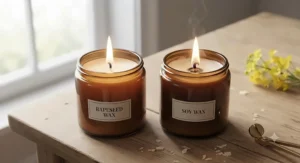
Here’s the short version. A rapeseed candle is made from hydrogenated oilseed rape oil — the same crop behind those blazing yellow fields you drive past every May — pressed and processed largely within the UK and Europe. A soy candle is made from hydrogenated soybean oil, a crop grown predominantly in the US, Brazil and Argentina and shipped a considerably longer way to reach your living room…
This piece digs into what that geography actually means for your carbon footprint, walks through seven real, currently available candles spanning budget to premium, and gives you a genuinely useful framework for choosing between them. No fabricated five-star reviews, no invented lab results — just honest analysis built from real specs and real aggregated review sentiment, because that’s the only kind of “expert opinion” worth trusting.
What Is a Rapeseed Wax Candle vs a Soy Wax Candle?
A rapeseed wax candle is made from hydrogenated oil pressed from the Brassica napus plant, largely grown and processed in the UK and Europe, giving it comparatively short supply chains. A soy wax candle uses hydrogenated soybean oil, typically imported from the Americas, offering similar clean-burning properties but a longer, more carbon-intensive journey to your shelf.
Quick Comparison Table
| Feature | Rapeseed Wax | Soy Wax | Best For |
|---|---|---|---|
| Primary UK/EU growing region | Grown extensively across the UK (East Anglia, Yorkshire, Scotland) | Rarely grown in the UK; imported from the US, Brazil, Argentina | Rapeseed for local sourcing |
| Typical melting point | Around 55-60°C | Around 45-51°C | Soy for cooler-room stability |
| Scent throw | Strong, holds fragrance well in pillar form | Softer throw, excels in container candles | Soy for subtle everyday scenting |
| Vegan status | Vegan | Vegan | Tie |
| UK “candle miles” | Generally lower | Generally higher, depending on brand sourcing | Rapeseed for lower transport footprint |
| Typical price range | Around £15-£35 per candle | Around £12-£30 per candle | Roughly comparable |
Looking at the table above, rapeseed wax’s biggest practical advantage isn’t performance — it’s proximity. Because the crop is grown across huge swathes of the British countryside, a UK-poured rapeseed candle can genuinely claim shorter “candle miles” than most soy alternatives, which typically cross an ocean before they’re even melted. Soy still holds its own on scent throw in smaller container candles, and neither wax is inherently “better” for everyone; it depends what you’re optimising for, cost, throw, or provenance.
💬 Found a comparison that actually helps? Share it with someone who’s still burning paraffin!😊
Top 7 Rapeseed & Soy Candles: Expert Analysis
We’ve pulled together seven genuinely available candles — spanning budget, mid-range and premium — covering both wax types so you can compare like-for-like rather than guessing from marketing copy.
1. St Eval Sandalwood & Cedar Candle (Lamorna Collection) — Cornish-poured rapeseed wax with B Corp credentials
The St Eval Sandalwood & Cedar Candle is hand-poured on a working farm in North Cornwall, and that provenance is the whole point of buying it. Made from natural rapeseed wax rather than a paraffin blend, it’s designed to burn cleaner and slower than mass-market alternatives, with a woody, warming scent profile built around sandalwood, cedar and a hint of sweet red berries. St Eval is a certified B Corporation, meaning its environmental and social practices are independently audited rather than self-declared, which is worth something in a category full of vague “eco” claims. Based on the brand’s positioning and rapeseed’s known burn characteristics, this is a strong pick for anyone who wants a UK-grown wax with a proper glass vessel rather than a tin. Reviewers consistently note the fragrance is well-balanced rather than overpowering, and that the glass jar looks smart enough to leave out rather than hide away. What most buyers overlook is that rapeseed wax’s higher melting point means it can take slightly longer to develop a full wax pool on first light — patience pays off with a cleaner burn later on.
Pros:
- ✅ Hand-poured in Cornwall using UK-grown rapeseed wax
- ✅ B Corp certified, independently audited sustainability practices
- ✅ Reusable glass vessel suited to repurposing
Cons:
- ❌ Premium pricing compared with supermarket own-brand candles
- ❌ Slower initial wax pool due to rapeseed’s higher melt point
Expect to pay in the mid-£20s to low-£30s range for this size; given the sourcing transparency and reusable vessel, it’s a fair value verdict for buyers prioritising provenance over price.

2. NAKENDLE Coconut & Rapeseed Wax Candle — handmade ceramic vessel built for reuse
The NAKENDLE Coconut & Rapeseed Wax Candle pairs a coconut-rapeseed wax blend with a hand-poured ceramic container designed to be washed out and reused once the candle is spent, rather than binned like a typical glass jar. Blending coconut wax into the rapeseed base softens the melt point slightly and tends to improve scent throw compared with rapeseed alone, based on how these two waxes typically interact in formulation. The brand markets itself explicitly against paraffin and “low-quality soy,” which is a bold claim worth treating as marketing rather than verified fact, but the underlying wax blend genuinely avoids petroleum derivatives. This is a strong match for buyers who care as much about what happens to the container after the wax is gone as they do about the wax itself — chic ceramic pots double as trinket dishes or planters. Aggregated feedback on small-batch candle brands like this tends to praise the tactile, gift-ready packaging, though independent, verifiable review volume is limited for newer artisan brands, so treat any single glowing review with a pinch of salt.
Pros:
- ✅ Reusable ceramic vessel reduces long-term container waste
- ✅ Coconut-rapeseed blend improves scent throw over rapeseed alone
- ✅ Hand-poured in small batches with visible craftsmanship
Cons:
- ❌ Limited independent review volume to verify burn-time claims
- ❌ Premium ceramic packaging pushes the price above basic jar candles
At around £20-£30, the value case rests on the reusable vessel; if you’ll actually repurpose the ceramic pot, the maths works out better than a single-use glass jar over time.
3. Matty’s Candles Coconut & Rapeseed Wax Candle — everyday rapeseed blend at a mid-range price
Matty’s Candles builds its entire collection around a coconut and rapeseed wax blend, positioning the brand as an accessible entry point into rapeseed-based candles rather than a luxury purchase. The blend is chosen specifically for a clean, long-lasting burn with strong fragrance retention, which matters because rapeseed wax on its own can sometimes struggle with scent throw in smaller container formats. What the spec sheet won’t tell you, but the brand’s own sourcing notes make clear, is that rapeseed is grown as a “break crop” in UK arable rotations — meaning farmers plant it partly to improve soil health between cereal harvests, not purely for wax production, which somewhat strengthens its sustainability case versus a monoculture crop grown solely for fuel or fragrance. This candle suits buyers who want the rapeseed wax candles eco friendly story without paying Cornish-farm prices for it. It’s a sensible middle-ground pick for someone dipping a toe into rapeseed wax for the first time.
Pros:
- ✅ Mid-range pricing makes rapeseed wax accessible
- ✅ Coconut blend boosts fragrance retention over pure rapeseed
- ✅ Rapeseed sourced as a UK arable break crop, supporting soil health
Cons:
- ❌ Less prestigious branding than heritage names like St Eval
- ❌ Scent range is smaller than more established competitors
Typically priced in the high-teens to low-£20s range, this candle offers solid value for buyers who want rapeseed’s provenance story without the premium markup.
4. The Pure Candle Company 100% Soy Wax Candle — UK-poured soy with locally created fragrances
The Pure Candle Company pours its candles by hand in a Northumberland studio using 100% soy wax and fragrance oils sourced and created in the UK, which is a meaningfully different proposition to a soy candle poured overseas from imported fragrance blends. Soy wax’s lower melting point compared with rapeseed means this candle should reach a full, even wax pool faster on first burn, reducing the tunnelling risk that frustrates newer candle owners. Based on the spec comparison with rapeseed alternatives, 100% soy wax candles like this one tend to offer a softer, more diffused scent throw rather than the punchier projection you get from harder waxes — better suited to bedrooms and smaller rooms than open-plan kitchens. The brand also emphasises washable, reusable glass containers, addressing one of the more legitimate criticisms of soy candles generally. For buyers who want soy specifically but still care about “locally sourced wax” fragrance and production, even if the soybeans themselves are imported, this narrows that gap about as far as it currently goes in the UK market.
Pros:
- ✅ 100% soy wax with UK-created and UK-sourced fragrance oils
- ✅ Handmade in Northumberland, shortening the finishing supply chain
- ✅ Washable glass jars designed for reuse
Cons:
- ❌ The soybean crop itself is still imported, unlike UK-grown rapeseed
- ❌ Softer scent throw than rapeseed or coconut-blend alternatives
Priced broadly in the £20-£30 range depending on size, this is one of the more transparent soy options if UK-based production matters to you even when the raw crop doesn’t originate here.
5. Stoneglow Nature’s Gift Natural Wax Candle — botanical-led natural wax blend manufactured in the UK
Stoneglow has over three decades in candle-making and manufactures its entire Nature’s Gift range in-house in the UK, blending natural waxes with essential oils and, in some lines, botanicals the company grows and harvests itself. This particular candle leans on a natural wax blend rather than being marketed as single-source soy or rapeseed, and the brand is upfront that its exact formulation is a proprietary blend — a reasonably common practice worth flagging honestly rather than assuming it’s “pure” anything. What most buyers overlook about blended natural wax candles is that they often outperform single-source waxes precisely because blending lets manufacturers balance melt point, scent throw and burn time rather than being stuck with one wax’s limitations. Aggregated customer sentiment for Stoneglow skews strongly positive on scent complexity and UK manufacturing transparency, with the brand’s cruelty-free, recyclable-packaging commitments giving it credible sustainability positioning beyond the wax itself. This suits buyers who want a “best of both worlds” natural wax without needing to pick a side in the rapeseed candle vs soy candle debate.
Pros:
- ✅ Manufactured entirely in the UK with hand-blended fragrance
- ✅ Botanical natural wax blend balances throw and burn quality
- ✅ Recyclable packaging and cruelty-free production commitments
Cons:
- ❌ Exact wax blend ratio isn’t fully disclosed on the label
- ❌ Sits at a premium price point versus single-wax competitors
Expect to pay around £25-£35; the value verdict is strong if UK manufacturing and formulation expertise matter more to you than wax-type purity.
6. WoodWick Large Hourglass Candle — soy-paraffin blend with a signature crackling wick
The WoodWick Large Hourglass Candle is worth including precisely because it illustrates a common labelling trap: it’s marketed prominently around its “premium soy wax,” but the full ingredient blend also contains paraffin, and the brand is reasonably transparent about this on the product listing itself. The wooden Pluswick wick is the genuine differentiator here, producing a soft crackling sound as it burns that pure rapeseed or soy candles simply can’t replicate, and it’s this sensory feature — not eco-credentials — that drives WoodWick’s popularity. Based on the spec comparison, a soy-paraffin blend like this typically burns hotter and throws scent further than a 100% natural wax candle, which explains why it remains a bestseller for larger open-plan rooms despite the sustainability trade-off. Reviewers consistently praise the fireplace-like ambience and strong scent throw, while a recurring criticism in aggregated feedback is that the wooden wick needs regular trimming to avoid excess soot — a maintenance step many buyers skip. If your priority is atmosphere over provenance, this remains a genuinely strong product; if it’s the wax type specifically, it’s the weakest sustainability pick on this list.
Pros:
- ✅ Distinctive crackling wooden wick creates a fireplace-like ambience
- ✅ Strong scent throw suited to larger rooms
- ✅ Widely available with a broad, well-reviewed fragrance range
Cons:
- ❌ Contains paraffin alongside soy, diluting its eco-friendly claim
- ❌ Requires regular wick trimming to prevent sooting
Priced around £20-£35 depending on size, it’s fair value as a sensory candle but a weaker choice if your primary goal is minimising environmental impact.
7. Candles By Luma Soy Wax Candle — budget-conscious, vegan, handmade soy option
Candles By Luma positions itself explicitly around organic, handmade and vegan soy wax candles, aiming to make sustainable candle alternatives more affordable without cutting corners on cruelty-free sourcing. The brand’s own reasoning — that soy wax costs slightly more than paraffin but pays that back through longer burn times and better fragrance retention — lines up with the wider industry consensus on soy’s performance versus mass-market paraffin. Reviewers consistently highlight value for money as the standout factor, particularly for buyers testing whether they prefer soy to rapeseed before committing to pricier artisan brands. As with any smaller-batch soy producer, sourcing transparency on exactly where the soybeans are grown isn’t always published in detail, so buyers who care deeply about supply-chain traceability may want to contact the brand directly before assuming best-practice sourcing. This is a sensible starting point for anyone comparing rapeseed wax candles eco friendly claims against soy without wanting to spend premium-brand money to do it.
Pros:
- ✅ Genuinely budget-friendly entry point into soy wax candles
- ✅ Vegan and cruelty-free positioning throughout the brand
- ✅ Handmade in small batches with decent fragrance retention
Cons:
- ❌ Limited public detail on soybean sourcing and farming practices
- ❌ Smaller scent range than larger, more established competitors
At roughly £10-£20, this is the most accessible entry point on this list, and a sensible value verdict for budget-conscious buyers testing soy wax for the first time.
Top 7 Comparison Table
| Product | Wax Type | Price Range | Best For |
|---|---|---|---|
| St Eval Sandalwood & Cedar Candle | Rapeseed | £25-£35 | UK provenance and B Corp credentials |
| NAKENDLE Coconut & Rapeseed Candle | Coconut-Rapeseed blend | £20-£30 | Reusable ceramic vessel lovers |
| Matty’s Candles Coconut & Rapeseed Candle | Coconut-Rapeseed blend | £15-£25 | First-time rapeseed wax buyers |
| The Pure Candle Company Soy Candle | 100% Soy | £20-£30 | UK-made fragrance, softer throw |
| Stoneglow Nature’s Gift Candle | Natural wax blend | £25-£35 | Balanced blend, UK manufacturing |
| WoodWick Large Hourglass Candle | Soy-Paraffin blend | £20-£35 | Ambience and scent throw over eco-purity |
| Candles By Luma Soy Candle | Soy | £10-£20 | Budget-friendly soy entry point |
Scanning this table, the clearest pattern is that pure or near-pure rapeseed options like St Eval and blended options like Matty’s Candles consistently edge out WoodWick on sustainability credentials, even though WoodWick wins on raw sensory experience. If budget is the deciding factor, Candles By Luma delivers the lowest entry price without abandoning soy’s genuine performance benefits over paraffin.
✨ Ready to compare these side by side? Check current pricing and availability before they sell out!
Real-World Scenarios: Which Candle Suits You?
Picture three different buyers browsing the same candle aisle. Sarah lives in a rented flat in Bristol, burns candles most evenings, and cares deeply about reducing her carbon footprint without breaking a modest budget — for her, Matty’s Candles Coconut & Rapeseed Wax Candle hits the sweet spot of UK-grown provenance and accessible pricing, letting her burn nightly without guilt or overspending.
Then there’s Tom, who works from home and wants a statement candle for his living room that also functions as decor once it’s finished — the NAKENDLE Coconut & Rapeseed Wax Candle‘s reusable ceramic vessel solves two problems at once, giving him a planter or trinket dish for free once the wax is gone.
Finally, consider Priya, who’s redecorating a large open-plan kitchen-diner and wants scent that actually fills the space during dinner parties. Pure rapeseed or soy candles can struggle to throw scent across bigger rooms, so the WoodWick Large Hourglass Candle‘s soy-paraffin blend and crackling wick genuinely earns its keep here, even accepting the sustainability trade-off. Matching the candle to the room size and lifestyle, not just the wax label, is often the difference between a candle you love and one that sits half-burned on a shelf.
Common Candle Problems, Solved
Problem 1: Tunnelling, where the candle burns a narrow hole down the middle. This happens most often with harder waxes like rapeseed if the first burn is cut short. Solution: let any new rapeseed candle burn until the entire top surface has melted edge to edge on its first light, even if that takes over an hour.
Problem 2: Weak scent throw in a soy candle. Soy wax naturally throws scent more gently than rapeseed or paraffin blends. Solution: burn soy candles in smaller, enclosed rooms rather than open-plan spaces, and consider a candle with a coconut or blended wax base if you need stronger projection.
Problem 3: Sooting on wooden-wick candles like WoodWick. Untrimmed wicks are almost always the cause. Solution: trim the wick to roughly 6mm before every single light, without exception.
Problem 4: Uneven, “wet” wicks that won’t stay lit. This usually means the wax pool is too deep too soon. Solution: keep burns to two to four hours at a time and let the candle fully cool before relighting.
Problem 5: Confusing genuinely eco-friendly candles with greenwashed ones. Many brands lean hard on words like “natural” without disclosing full wax blends. Solution: check the ingredients list specifically for the wax percentage breakdown rather than trusting front-of-pack claims alone.
Rapeseed Wax Candles: What Makes Them Eco-Friendly?
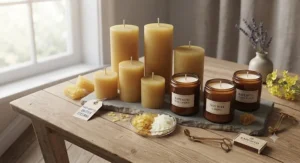
Rapeseed wax candles eco friendly claims rest on a few genuinely defensible pillars rather than marketing spin. First, the crop itself: oilseed rape is grown extensively across UK farmland as both a food crop and a break crop within arable rotations, meaning wax producers are drawing on an existing, diversified agricultural system rather than a monoculture grown solely for candle production. Second, rapeseed wax is fully biodegradable and renewable, unlike paraffin, which is a petroleum by-product that will never decompose in any meaningful timeframe. Third, and most practically for UK shoppers, rapeseed wax candles typically travel a far shorter distance from field to finished product than soy, since the crop grows abundantly across East Anglia, Yorkshire and Scotland rather than needing to cross the Atlantic.
None of this makes rapeseed wax flawless. Rapeseed farming still relies on nitrogen fertiliser and pesticide inputs at scale, which carries its own environmental cost through soil and water impacts, and yields have fluctuated significantly in recent UK growing seasons due to pest pressure from the cabbage stem flea beetle. Honest sustainability credentials acknowledge these trade-offs rather than pretending rapeseed wax is a perfect, guilt-free product — it’s meaningfully better than paraffin, genuinely competitive with soy, but not without its own agricultural footprint.
Which Wax Is Most Eco-Friendly? Rapeseed vs Soy vs Beeswax vs Paraffin
Answering which wax is most eco friendly properly requires comparing across the full lifecycle rather than picking a single favourite metric. Here’s how the four most common waxes stack up:
| Wax Type | Renewable? | Typical Origin | Biodegradable? | Key Trade-Off |
|---|---|---|---|---|
| Rapeseed | Yes | UK/Europe | Yes | Fertiliser and pesticide inputs |
| Soy | Yes | US/South America | Yes | Longer transport, deforestation risk in some regions |
| Beeswax | Yes (animal-derived) | UK/global apiaries | Yes | Limited supply, higher cost, relies on bee populations |
| Paraffin | No | Global oil refining | No | Fossil-fuel derived, non-biodegradable |
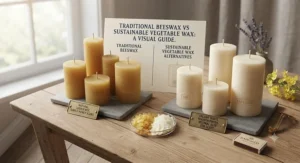
Interpreting this table, no single wax wins on every metric simultaneously. Beeswax arguably has the strongest sustainability profile in isolation, but limited global supply and dependence on healthy bee populations make it impractical as a mass-market substitute for paraffin. Between rapeseed and soy specifically, rapeseed tends to edge ahead for UK buyers purely on transport distance and local agricultural integration, while soy remains more globally scalable and slightly more widely available. Paraffin, regardless of price, sits clearly last on every meaningful environmental measure.
Understanding the Carbon Footprint of Candles
Carbon footprint candles comparisons rarely make it into product descriptions, but the underlying data tells a genuinely interesting story. Peer-reviewed life-cycle analysis of UK rapeseed-derived products found that rapeseed agriculture itself accounts for the majority of associated carbon emissions, driven primarily by nitrogen fertiliser use, before the crop is even processed into wax or fuel — a reminder that “grown locally” doesn’t automatically mean “zero impact.” Transport still matters enormously, though: shorter supply chains generally correlate with materially lower transportation-related emissions compared with feedstocks shipped internationally.
For soy, the carbon footprint calculation depends heavily on where the soybeans were farmed. Soy grown on land converted from established forest carries a substantially heavier carbon burden than soy grown on existing agricultural land, which is why sourcing transparency matters as much as the wax type itself when you’re trying to make a genuinely lower-carbon choice. In practice, a UK-poured rapeseed candle using domestically grown rapeseed will typically carry a lower transport-related carbon footprint than an imported soy candle, even before accounting for the fertiliser and land-use variables on both sides. Neither figure is perfect or fully standardised across brands, which is exactly why independent, brand-specific carbon disclosures remain rare — and why healthy scepticism of blanket “carbon neutral” claims on candle packaging is warranted.
Why Locally Sourced Wax Matters
Locally sourced wax isn’t just a feel-good marketing phrase — it has a measurable effect on a candle’s overall footprint through what the industry sometimes calls “candle miles,” the cumulative distance raw materials travel before reaching a finished product. Recent industry analysis suggests UK oilseed rape cultivation has been recovering after a difficult decade of pest pressure, with a coordinated industry effort helping yields rebound significantly in the 2024/25 growing season, which is genuinely good news for UK-based rapeseed wax producers hoping to keep sourcing domestically rather than importing.
For soy, “locally sourced” is a much harder claim to make honestly in a UK context, since the crop simply isn’t grown commercially here at any meaningful scale — any soy candle marketed as “locally sourced” almost certainly means the finishing, pouring or fragrance blending happened locally, not the raw soybean farming. That’s not necessarily dishonest, but it is a distinction worth understanding before you pay a premium for a “local” label. If sourcing distance is genuinely your top priority, rapeseed wax currently has the stronger claim among mainstream options for UK buyers, simply because the crop itself grows here.
Sustainable Candle Alternatives Worth Considering
Beyond the rapeseed-versus-soy debate, sustainable candle alternatives worth knowing about include coconut wax, often blended with rapeseed or soy to improve scent throw and burn quality; beeswax, which offers strong sustainability credentials in small batches but doesn’t scale affordably; and refillable candle systems, where you buy a permanent vessel once and purchase wax refills afterwards, cutting down on repeated glass or ceramic waste. Wax melts using the same eco-conscious bases are also worth considering for anyone who wants fragrance without an open flame, since they typically use less wax per scenting session than a full candle burn.
It’s also worth flagging what doesn’t count as a meaningful sustainable alternative, regardless of how it’s marketed: candles labelled simply “natural” without a specific wax breakdown, and blends where paraffin makes up the bulk of the formulation with only a token percentage of plant wax added for the label. Reading the actual ingredients list, not just the front-of-pack claim, remains the single most reliable way to separate genuinely sustainable candle alternatives from greenwashed ones.
Rapeseed Candle vs Soy Candle: The Full Comparison
Put head-to-head, the rapeseed candle vs soy candle decision comes down to a handful of concrete differences rather than vague vibes. On sourcing, rapeseed wins decisively for UK buyers, since the crop grows domestically while soy is imported. On melting point and scent throw, soy generally has a lower melt point, which some buyers find easier to work with, while rapeseed’s higher melt point and firmer texture tend to hold fragrance oils more effectively over a longer burn. On price, the two are broadly comparable once you control for brand positioning rather than wax type alone — premium brands charge premium prices regardless of which plant the wax came from.
On availability, soy currently has a larger global market share and a wider range of established brands to choose from, partly because US soy production infrastructure for candle wax is more mature than the UK’s rapeseed wax industry. On environmental credentials specifically, the honest answer is that rapeseed narrowly edges ahead for UK-based buyers due to transport distance, but soy remains a genuinely defensible choice, particularly from brands that disclose responsible, non-deforestation sourcing. Neither wax is the villain here — paraffin remains the clear environmental laggard in this category, and choosing either rapeseed or soy over paraffin is the meaningful upgrade, regardless of which one you personally prefer.
How to Choose Between Rapeseed and Soy Candles
- Check where the wax is actually grown, not just where the candle is poured. A candle “handmade in the UK” using imported soy is a different sustainability proposition to a UK-grown rapeseed wax candle, even if both are poured in the same workshop.
- Match the wax’s melt point to how you’ll burn it. Rapeseed’s firmer texture suits pillar candles and longer burns; soy’s softer texture suits smaller container candles you’ll relight often.
- Read the full ingredients list for blend percentages. Many “soy” or “natural wax” candles are blends, not pure single-source waxes — that’s not automatically bad, but you should know what you’re buying.
- Weigh scent throw against room size. If you need a candle to fill a large space, a coconut-rapeseed or soy-paraffin blend will usually outperform a pure single-source wax.
- Factor in the vessel, not just the wax. A reusable glass or ceramic container adds genuine long-term sustainability value beyond the wax type itself.
- Compare price per burn hour, not just sticker price. A slightly pricier candle with a longer stated burn time often works out cheaper over the candle’s full life.
- Look for independent certifications where available. B Corp status, cruelty-free labelling and transparent sourcing statements carry more weight than unverified “eco-friendly” claims on packaging alone.
Common Mistakes When Buying Eco-Friendly Candles
The single most common mistake is trusting the word “natural” on its own, without checking the actual wax percentage breakdown — plenty of candles marketed this way still contain significant paraffin content. A second frequent error is assuming a higher price automatically means a lower environmental footprint; premium branding and genuine sustainability don’t always move together. Buyers also regularly underestimate how much wick maintenance affects both performance and indoor air quality: research on scented candle emissions shows particulate matter levels can rise noticeably near a burning candle, regardless of wax type, which makes trimming wicks and ventilating rooms a genuinely meaningful habit rather than an optional extra.
Another mistake is ignoring the vessel entirely and focusing purely on the wax — a rapeseed candle in a single-use tin isn’t necessarily more sustainable overall than a soy candle in a genuinely reusable glass jar. Finally, many buyers assume “vegan” and “eco-friendly” are interchangeable; both rapeseed and soy waxes are vegan, but that says nothing about the carbon footprint of the fragrance oils, packaging or shipping distance involved.
FAQ
❓ Is rapeseed wax better than soy wax for candles?
❓ Are rapeseed candles vegan?
❓ Do soy candles burn cleaner than paraffin candles?
❓ Can I mix rapeseed and soy wax when making my own candles?
❓ Which wax lasts longer, rapeseed or soy?
Conclusion
If you take one thing away from the rapeseed candle vs soy candle debate, let it be this: both are a genuine upgrade over paraffin, and the “right” choice depends on what you’re optimising for rather than which wax wins some universal eco crown. Rapeseed wax makes the stronger locally sourced wax case for UK buyers, with a firmer texture that suits pillar candles and longer burns, while soy offers a gentler scent throw, broader availability and a slightly lower melting point that some buyers find easier to live with day to day.
Across the seven candles covered here, St Eval and Matty’s Candles make the clearest rapeseed-forward, UK-provenance case, The Pure Candle Company and Candles By Luma cover soy at different price points, NAKENDLE and Stoneglow blend the two philosophies with reusable vessels and proprietary natural blends, and WoodWick remains worth knowing about precisely because it shows how easily “soy” branding can obscure a paraffin blend underneath. Whichever wax you land on, checking the actual ingredients list, the vessel’s reusability and the brand’s sourcing transparency will tell you far more than any single marketing claim on the box.
Recommended for You
- Best Rapeseed Candles UK 2026: 7 Sustainable Picks Reviewed
- Luxury Coconut Wax Candles 2026: 7 Blissful Buys Worth It
- Coconut Wax vs Soy Wax Candles: 7 Picks Compared (2026)
Disclaimer: This article contains affiliate links. As an Amazon Associate, I earn from qualifying purchases. If you purchase products through these links, we may earn a small commission at no additional cost to you.
✨ Found this helpful? Share it with your friends! 💬🤗
